Enjoying Your Own Decline

Nobody likes to talk about it, but the decline is coming. I’m not talking about economics, western culture, or common courtesy. I’m talking about us. You and me. Life is a mountain with two sides, and no matter how high you climb, you’ll still end up at the very bottom someday. Even the god-like pharaohs landed there, and the treasure in their tombs was eventually plundered. That’s how it goes. If you’re lucky, you’ll live long enough to experience the decline as a gradual downward slope. For others, it’s more like a cliff. One thing is certain: decline is coming.

It may be your strength. It may be your beauty. It may be your mind. It may be your influence, the relevance of your work, your notoriety, or your social prominence. Eventually, it will be all of the above. I guess it makes sense that we don’t like to talk about this. It sounds dire, doesn’t it? And yet I’ve witnessed people living out the years of their decline with a strange, luminous joy that refused to track with their diminishing abilities and strength—on the contrary, it actually grew stronger and brighter as they weakened and let go. How is this possible? I want to know, because I want that joy.

Continue reading Enjoying Your Own Decline


A Time To Be Tired

In Ecclesiastes 3, Solomon famously says that “There is a time for everything, and a season for every activity under the heavens”. For example, he says that there is “a time to be born and a time to die, a time to plant and a time to uproot”, there is “a time to weep and a time to laugh, a time to mourn and a time to dance”, and the list goes on. It’s a long list, but it isn’t exhaustive, and I’d like to propose another pair that fits the theme:

There is a time to save your strength, and a time to spend it.

Continue reading A Time To Be Tired

Wanting What I Already Have

There are strings of lights and stacks of chocolates growing in the shops, and the annual question is already hanging in the air: what do you want for Christmas? Mind you, the answer is meant to be something that fits neatly inside of wrapping paper, under a tree or in a stocking. ’Tis the season to assess what we all have and (more specifically) don’t have so that we can give each other good gifts that are actually wanted. I’m all for it. Social pressure to think about other people’s desires and happiness is a good thing, and if other people are thinking about my desires as well, that’s not bad. But as we all think hard about what everyone wants and doesn’t have yet, I’d like us to pause for a moment and remember a truth that can easily get lost in the flurry of festivities: it is possible to want what you already have.

Continue reading Wanting What I Already Have

The Cost Of Greatness (a poem)

Can you bear the cost of greatness
In the kingdom of our Lord?
You can’t buy it with your money
Or take it with a sword

Will you let yourself be overlooked
And measured as the least?
Can you bear to serve the tables
For the others as they feast?

Let your patience be called weakness
Let your love be misconstrued
Let them scorn your sacrifices
And speak evil of your good

Can you give away your rights
Without demanding recognition?
Quench the thirst of enemies
While they reload their ammunition?

Plough your years into the soil
Till your neighbour’s garden blooms
And keep on being generous
When everyone assumes
That the credit for the good you’ve done
Is everyone’s but yours—
And when they say your work’s in vain
Still keep a steady course

Can you offer up forgiveness
To the ones who’ve done you wrong?
Can you bend your neck into the yoke
And still lift up a song?

The climb to heaven’s greatness
On the pathway of our Lord
Is a climb that takes you downward
To his unending reward


“Whoever wants to become great among you must be your servant, and whoever wants to be first must be your slave—just as the Son of Man did not come to be served, but to serve, and to give his life as a ransom for many.”

– Matthew 20:26-28

Patrick Loved Ireland Before Ireland Loved Patrick

On the 17th of March, people around the world will celebrate Ireland’s national holiday, St. Patrick’s Day. Is there any other national holiday in the world that is celebrated as internationally as Ireland’s? It is truly unique. So as the bunting goes up and the landmarks turn green and the parades are organised, it’s worth remembering the man who inspired this global celebration. 

Like the holiday named after him, Patrick’s life was truly unique. He did not consider himself a great man, and would likely be uncomfortable with the extravagance of the yearly honours we bestow on him. In his autobiography, he calls himself “a simple country person, a refugee, and unlearned.” The reason he calls himself a “refugee” is because his connection with Ireland, which is how everyone remembers him today, only began when he was sixteen—and it wasn’t a good start at all. The first Irish people that Patrick met were the people who raided his hometown (probably in Wales) and carried off thousands of prisoners—including Patrick—to be sold into slavery in Ireland. Our patron saint’s first sighting of Ireland’s beautiful shores came while he was in the chains of human traffickers. In Ireland, Patrick tells us that he was “brought low by hunger and nakedness daily.” His slavery continued until he was twenty-two years old. This is not the part of the story we celebrate on March 17th.

Continue reading Patrick Loved Ireland Before Ireland Loved Patrick

Don’t Let All The Conspiracies Be Evil

The headlines are usually bad. Nations conspiring against nations, scandals and corruption in governments, corruption and abuse in charities, organised crime, businesses cheating the system, people cheating each other, and so on. It seems there are a lot of people in this world working hard to devise evil plans and then working together to carry them out. Which is nothing new. Isaiah wrote about the same thing hundreds of years before the first Christmas:

“…the schemes of the schemer are evil;
He devises wicked plans
To destroy the poor with lying words,
Even when the needy speaks justice.”
– Isaiah 32:7 (NKJV)

Continue reading Don’t Let All The Conspiracies Be Evil

Looking Out For Number Two

“Look out for Number One” they say, “if you don’t, no one else will.”

Actually, it wasn’t some generic “they” who said this first, it was Arnold “The Brain” Rothstein. He was boss of the Jewish mob in New York City during the Prohibition era, so I guess you could say he lived it out, too. He certainly took care of himself. He probably took care of a lot of other people as well, if you know what I mean.

Maybe the quote is too vague. There are just so many ways of “looking out” for yourself. Thankfully, most people don’t do it by becoming kingpins. But we still take the kingpin’s advice: Look out for number one. Follow your own bliss. Take care of your own self. After all, The Brain’s logic seems bullet-proof: “if you don’t, no one else will.” Isn’t that how the world works?

Continue reading Looking Out For Number Two

More Than You Can Handle

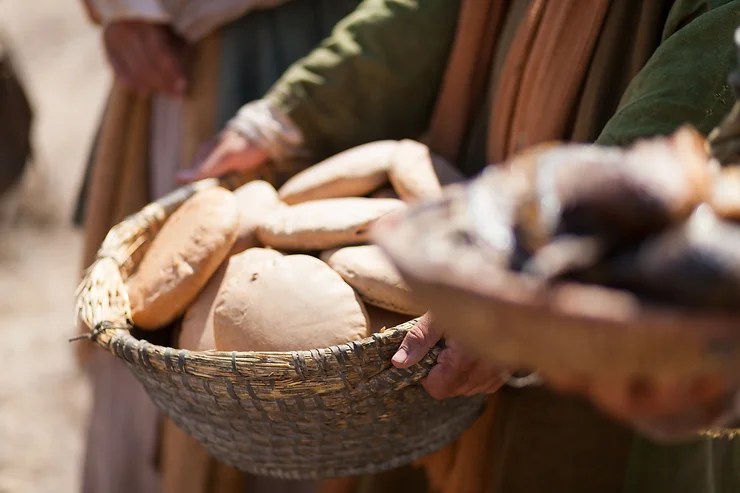
John the Baptist was dead. Beheaded. It was unjust, brutal, and senseless. On hearing the news, Jesus left what he was doing and went with his disciples to a solitary place. He must have wanted to mourn, and pray, away from the crowds. But when he arrived, there was no solitude: somehow, word had spread about where he was going, and now a large crowd was waiting for him. Matthew records that Jesus didn’t send them away or throw himself a pity party—“he had compassion on them and healed their sick.” They were suffering, too. 

As the day wore on, Jesus’ disciples began to be concerned: what would these people eat for dinner, out there in the middle of nowhere? No one had planned logistics for a gathering like this. Taking stock of the situation, they made a practical suggestion that Jesus send the crowd away so that they could get to the villages and buy food for themselves. Jesus replied: “They do not need to go away. You give them something to eat.”

I’ve heard people say that “God will never give you more than you can handle.” I don’t think that’s true. Look at the job he gave his disciples: “you give them something to eat.” 

How?

Continue reading More Than You Can Handle

How To Never Burn Out

Have you noticed that people aren’t quite the same after the pandemic? Apparently, humans beings can’t just pause most of their normal life activities for two years and then suddenly switch it all back on again without any difficulties. There are difficulties. People are generally more tired doing the same things, which makes them less willing to commit to the same number of things, which leaves some things undone, or at least struggling to get done. This seems to be especially true for voluntary activities like the local committees and clubs and churches that hold communities together and serve the needy and vulnerable. Serving others in these ways takes time and energy; resources that are already being demanded by commitments we can’t get out of, so often the easiest option is to cut the voluntary activities out. It makes sense. We only have so much to give. If we’re not careful, we’ll burn out. But I know a way to keep that from happening.

Continue reading How To Never Burn Out