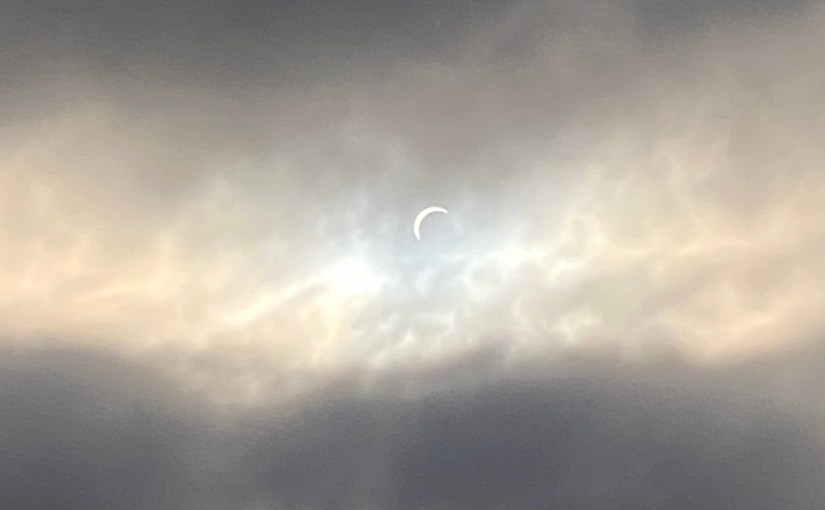
We stepped out of our front door into a eerily early twilight, as the moon began to cover the sun. From where we stood, the eclipse reached 96% coverage, at its height. One of the things that impressed me most about the experience was not how dark it became, but how much light remained when only 4% of the sun was shining. Even that small sliver of crescent-sun lit the world up more brilliantly than a full moon. The moon might be the main attraction at night, but it can’t compete. I’ve seen it in the morning, almost imperceptible against the sun-washed sky, even though it was still shining just as brightly as ever. More technically, it was still reflecting just as brightly as ever. The reason the moon can never compete with the sun is because every bit of light it shines with is received from the sun in the first place. It does not generate any light of its own. It can only give out of what it has been given.
That’s what makes the moon such a good reminder for us humans. As much as we love to talk about shining like stars and finding the light within us, our true situation is far more like the moon than the light-generating stars. The light we have is glorious, just like the moon’s—but like the moon’s, it is received. The apostle Paul asks, “What do you have that you did not receive? And if you did receive it, why do you boast as though you did not?” (1 Corinthians 4:7). You might argue that you worked very hard for everything you have, thank you very much—but where did you get your strength for that work? Where did you get the materials that you worked with? Where did you get your mind that planned, and your heart that willed? Where did you get your life? You received, before you gave anything. You are not a star. You are a moon.
There are implications. If our light comes from another source, then the best way to increase it is to receive more from that source, not to dig deeper within ourselves. Jesus said, “I am the light of the world. Whoever follows me will never walk in darkness, but will have the light of life” (John 8:12). He is the source, not you. He is the sun. You can reflect his light, or you can pretend his light is your own, if you want to. You can even go head-to-head with Jesus, trying to eclipse his glory with your own greatness—forgetting that every bit of greatness you have was received from his gracious gifts in the first place. When we saw the eclipse, it struck me that I’ve never seen the moon as completely dark as when I saw it blocking the sun. It became nothing more than a void, a blot in the sky, not only darkening itself but darkening the world, as well. In a competition between the sun and the moon, the moon has no light of its own to bring. It has two options: either block the sun, making itself and everything else darker in the process, or reflect it, making itself and everything else brighter. You have the same options, today.


Excellent analogy. I never thought about it quite like that.
LikeLiked by 1 person
Love this!! Thank you.
LikeLiked by 1 person