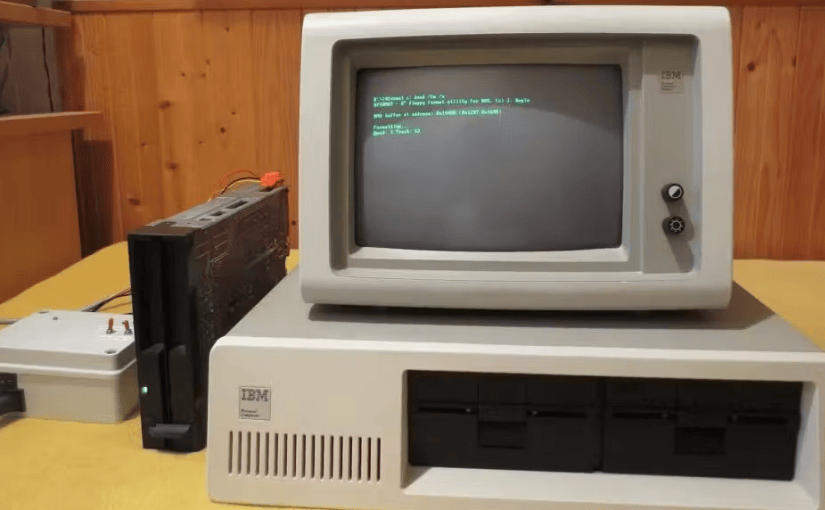
The museum had radios from the 1920’s and an original Edison record player. They had rotary phones with a working switchboard, and an early TV camera hooked up to an old TV. After that came the room full of old computers—and that’s where the experience changed, for me. I recognised them. I remember one of them sitting on the desk when I was growing up. I know how to put the floppy disks in those slots, and flip down the lock. The ATARI game system in the corner—the one my kids thought was so ancient—was the one I used to play on. I can show you how to blow on the cartridges to keep them working, if you want me to. But why would you?
Across from the ATARI, there were mobile phone models that I used to own displayed in a glass case. The stuff I used to carry in my pocket—in a museum display! I still remember how to type out texts with the number pad, pushing the 3 twice for an “e” and the 7 four times for an “s”. I guess that skill isn’t all that useful anymore.
Come to think of it, I have a lot of skills that aren’t very useful anymore. I remember my mom showing me how to use the card catalogue system at the library—those long cabinets with narrow drawers with thousands of unique little paper cards, one for every book in the entire collection. I learned how to use micro-film readers for research, as well. And phonebooks. I remember how proud I was when I mastered a trick that made it possible for me to tear old phonebooks in half with my bare hands. If you’re confused by that, just trust me—it was an impressive party trick. Not anymore, though, because there’s no such thing as phonebooks. They’ve been torn out of our lives entirely. My knowledge of how to use them and tear them is now obsolete.
Some knowledge and skills are obsolete for everyone, and others are just not that useful for me anymore, even if they are still used by others. I still know how to change nappies, but it’s been a long time since I’ve needed that skill. I don’t need the specialised knowledge I picked up working in a warehouse or at a paving company or serving tables at Ruby Tuesday’s. I don’t need to remember the street layout of the places I never go anymore. Over time, I’ve accumulated piles of information that I no longer need, and I don’t think I’m alone. I suppose we all have an ever-expanding memory bank of filed away skills and knowledge that all seem practically useless now, like artefacts in glassed-in museum displays.
Museum displays are not useless. They serve a very important purpose—they remind us of where we’ve come from. If we forget that, we’ll easily lose sight of where we are, maybe even who we are. Time moves on and we have to keep adapting, but it was the old knowledge and skills that helped us get here, and become who we are. That isn’t pointless, and it doesn’t just go away. Our old knowledge builds a contextual framework for us to better understand and adapt more appropriately to new situations. It can protect us, at least a little, from being overconfident about every new technology or overwhelmed by every new challenge. It can give us clearer perspective about new ideas and a clearer view of how the world works, and how systems and cultures and people change over time. So maybe my old, obsolete knowledge isn’t so obsolete, after all.


I forgot that’s how we used to text! The school bus was an orchestra of Nokia 3310 buttons clicking away, playing Snake or texting. Thanks for the nostalgia 🙂
LikeLiked by 2 people
This was a fun read! You are so right that we can build upon the past! Also, I think we can look at all these things and remember all the joy, mercies and blessings that God gave us through them!
LikeLiked by 1 person
Amen! I like that a lot, that’s a great point!
LikeLiked by 1 person