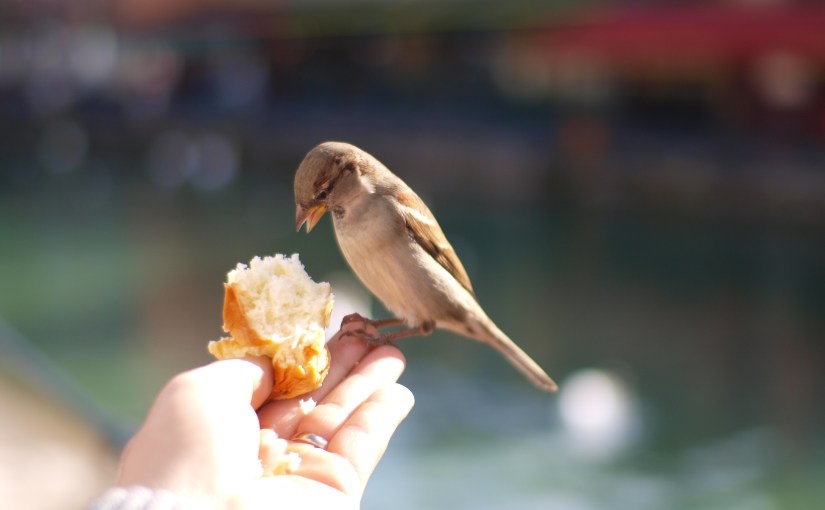
On a lakeshore in the French Alps, the old city of Annecy rises to meet the castle that crowns the hill. At the water’s edge, shops and restaurants trade in the same buildings that were used by medieval merchants. Our children were small when our family visited, but the memories are still clear in my mind. I remember the woman beside the water with a baguette, feeding the birds. I remember how fascinated the children were at how she could get the birds to come and eat bread right out of her hands. Then, when she noticed them noticing her, she generously gave the rest of her baguette to our family so that we could try it, too. Sure enough, a few bits of baguette was all it took to attract flocks of sparrows who flew around our heads, landed on our fingers and ate right out of our outstretched hands. Then again, who wouldn’t accept an invitation to share in a proper French baguette? As they came, we wondered at their tiny bodies, and we laughed at the feeling of their feet on our fingers. I suppose all animals will be this friendly and unafraid in the new creation. That will be glorious.
Continue reading Of Birds, Baguettes, And Being A CreatureTag: Nature
Appreciation Grows With Knowledge
The car windows were open, and Carlos Santana was making his guitar sing out of our stereo in ways that few can imitate. With the wind in her hair, my wife commented from the passenger seat that she reckoned people who play guitar probably appreciate his solos more than she could. She’s an experienced musician herself, but her instrument is piano. I play guitar—but I wouldn’t claim such a thing in front of Carlos. Still, even my amateur knowledge makes me see the truth in what my wife said. I’ve tried to learn my scales and unlock the hidden order of the fretboard and train my fingers to move freely along it—and I have not succeeded. When I hear someone whose mastery of the instrument is as complete as Santana’s, I think my own attempts—as small as they are—really do make me appreciate his abilities in a different way. My limited experience with the instrument gives me the beginnings of a context for the kind of work he must have put in day after day and year after year to develop his seemingly effortless (yet in reality hard won) talent. I’d imagine if I was more accomplished at guitar myself, I would appreciate the skill of masters like Santana even more. As my knowledge of music grows, my appreciation grows along with it.
Continue reading Appreciation Grows With Knowledge
Afternoon (a poem)
At first all I feel is
The stillness and peace—
The silence of grass and
The patience of trees
Then slowly my senses
Begin to attune
To the business of nature
This warm afternoon
The birds chatter on
With their intricate songs
And there must be a meaning
To what I am hearing
While bees move with vigour
From flower to flower
A butterfly, also—
Though his schedule’s lighter
And now I see flies
And some midges float by
And an ant—and the action
Is filling my eyes!
And though it is quiet
Compared to my screens
And though it is peaceful
There’s work for the trees
As they silently grow
And the ivy and gorse
And the grass-eating horse
For the peace of this earth
Isn’t lazy or languid
It’s busy and blessed
And yet somehow,
At rest

What The Mysteries Of The Universe Teach Us About God
Every so often I run across a news article about new discoveries that could reshape our understanding of the universe, or how some scientists are proposing new ways of thinking about the questions that continue to confound our best efforts of explanation. As our knowledge grows and our scientific theories continually shift in response, it’s obvious that our experts are still out of their depth in the mysteries of creation. It often seems that the more we find out about the universe, the more questions we end up having about it. For all we’ve discovered, we still don’t know some of the fundamental basics about how it works. Yes, we have theories like dark matter to explain anomalies we don’t understand, but we’ve never observed dark matter and we may very well be wrong about it. We theorise about black holes, and postulate about the meaning of ripples in the space-time continuum. At the heart of the physical universe that supports our lives, there are mysteries that still boggle our minds. We know this, and accept it, even as we work to understand more. But while people have learned to live with this tension in our knowledge of the fundamental realities of the universe, they often reject the exact same dynamic when it comes to the One who created the universe. If you think about this, it doesn’t make sense.
Why should we expect the Creator to be easier to understand than his creation? Wouldn’t we rather expect him to be even deeper, even broader and more expansive than anything he made? Wouldn’t he, of all things, be the most mind-blowing reality of all?
Continue reading What The Mysteries Of The Universe Teach Us About God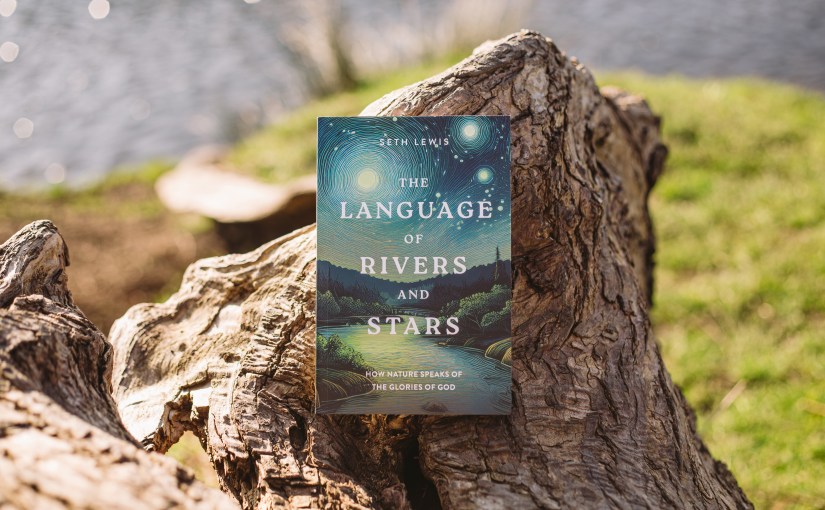
The Language of Rivers and Stars
While the children were off school this Easter our family took a trip to explore Mizen Head, the southernmost tip of Ireland. It’s a remote peninsula where the rocky, wild terrain is dotted with cottages of white or pale yellow and the land is a patchwork of squares and rectangles divided by low stone walls. Clusters of sheep and cows surround tiny villages with steeples in the middle and strings of houses and pubs and shops that might be out of eggs if you get there too late. At the southern point where the land runs out there’s an old signal station that’s become a tourist attraction, reached by a footbridge that stretches between impassable sea cliffs. When we walked across and looked down we saw three seals far below us, relaxing in a rocky inlet surrounded by towering, jagged rocks while the seagulls soared above our heads. In the far distance, we could just make out the shape of Fastnet Rock, a tiny island of stone where people managed—somehow—to build a lighthouse to warn those at sea of the ship-shattering dangers around them. At our feet the just-blooming sea-pinks waved in the breeze and I wondered again how these flowers manage—and even seem to prefer—to grow in places where there is so little soil and so much violent wind from the ever-turbulent ocean.
Continue reading The Language of Rivers and Stars
Transplanted
There’s an old Regency manor house near us that has been preserved as a heritage site, beautifully surrounded by manicured gardens that are faithfully tended by volunteers and open to the public. The gardens were planted and arranged over successive generations in the old English style—which means that the plants and trees were imported from all across the globe. This worked particularly well on the Fota estate because of its sheltered conditions. Even its name, Fota, is derived from the Irish “Fód te”, meaning “warm soil”. The arboretum is particularly impressive, boasting some of the finest specimens of pine, cypress and sequoia in Europe. There are also acers and eucalyptus, tasmanian tree ferns, acacia and magnolias that burst open with enormous flowers before the leaves even begin to appear. A walk through Fota gardens is a walk around the world, with the sights, smells, and colours of the Himalayas, Japan, Chile, China, New Zealand, the Pacific Northwest, and beyond.
Sometimes I’ve wondered how trees from California and Australia can grow so well in Ireland. I suppose they don’t have much of a choice in the matter, but they’ve certainly made the best of it. Their roots are deep in the fód te, and I have to strain my eyes to see some of their towering tops. They have not simply survived in a foreign land. They have made it their home, and thrived. When I wander among them, I am encouraged.
Continue reading Transplanted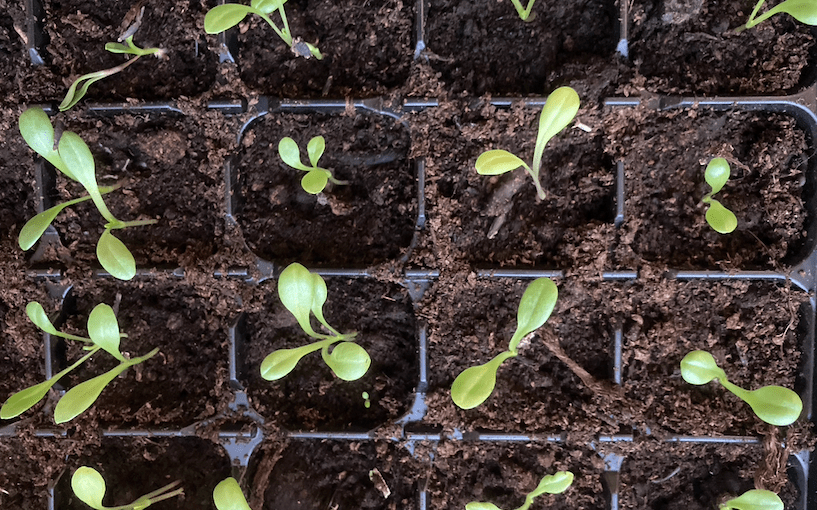
Seedlings Need The Weather (repost)
It’s the time of year when fresh green leaves are unfolding and Jessica is preparing trays of seedlings for our garden. A few years ago I wrote about what I learned from our seedlings, and I’ve been thinking a lot about those lessons recently, so I decided to repost this post for you today. If you look closely, you’ll see that God is constantly communicating many valuable truths to us through the world he made for us. That’s what my forthcoming book is about— “The Language of Rivers and Stars”.
There’s a small square of earth behind our house that belongs to us. Which is strange, because it was here a long time before we were and will be here a long time after we’re gone. But there’s a deed in an office somewhere that has our names on it, so the ground is ours. And with that ground comes the responsibility to care for it—a responsibility that didn’t come from an office, but from Heaven.
We do our best. And when I say “we”, I really mean my wife, Jessica. She’s the one who does most of the caring and tending and planting. I made the raised beds around the edges of the garden, but she’s the one that filled them with roses and blueberries, mint and strawberries, pineapple sage and climbing jasmine and passion flowers. This year, she brought home packets of seeds for dahlias, zinnias, and cornflowers as well, because she wants to have flowers to cut for our dinner table throughout the spring, summer, and autumn. She sowed the seeds in trays of compost and found the perfect spot inside our glass door where our seedlings could have ideal conditions: plenty of sun (by Irish standards), warmth inside the house, protection from cold and storms and slugs, and regular watering. We babied our little baby plants, and we were delighted to see them grow, and grow fast. In fact they grew so fast that their stems became long and thin and too weak to hold up their own new leaves. One by one me they began to fall over. What went wrong? How could our seedlings be so weak when we protected them from every difficulty and obstacle? What more could we do for them?
Continue reading Seedlings Need The Weather (repost)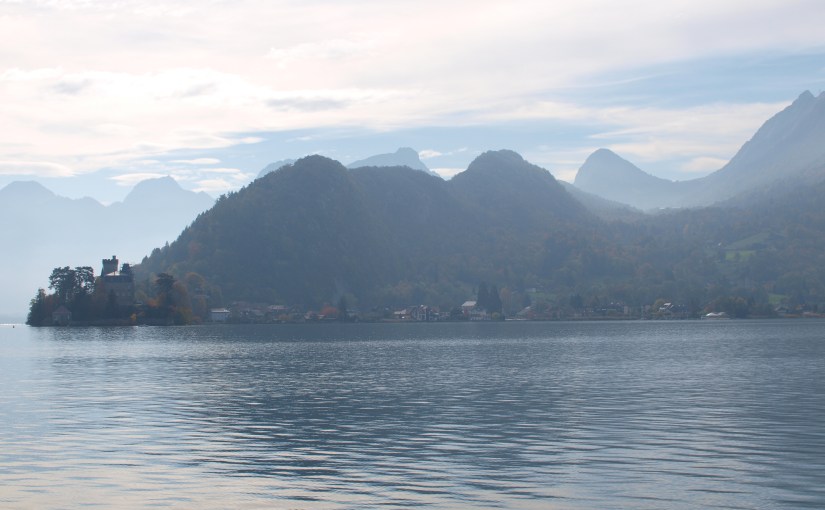
A City Whose Builder And Architect Is God
Have you ever noticed that illustrations of heaven tend to lean heavily on Greek architecture? The pillars and spires might be brighter, and the streets paved with gold, but the forms and styles still look familiar. It makes sense—the ancient Greek temples and forums were gorgeous, a true high point of human ingenuity and creativity. But these styles are human conceptions, whereas Hebrews 11:10 tells us that heaven is a city “whose architect and builder is God.”
Have you ever stopped to consider what it looks like when God himself designs and builds a city?
Continue reading A City Whose Builder And Architect Is God
Winter Walk (a poem)
I put my hands inside my sleeves
And stuff them in my pockets
My collar up against the wind
Is not enough to block it
But as my nose and ears complain
Of slowly freezing
In my brain
My thoughts are getting warmer
And more active with each step
This wind has fanned the flame—
Yes even frozen wind—and swept
My thoughts into a blaze
And I’m aware that if I kept
My body locked
Behind the glaze
In perfect comfort
All my days
That there my mind
Would rest in ease—
And in that warmth
Would slowly
Freeze
An Elegy For Our Fireplace
When my father built a home for our family in the hills of Alabama he put a large wood stove in the very centre. A good fire in that stove could heat the entire house, upstairs and down, for most of the night. I grew up splitting logs and carrying them in, building fires and learning to finesse small sparks into roaring warmth. They say firewood warms you twice, and it’s true—first when you cut it, and again when you burn it. The sound of our fire sucking air through the stove vents like breath, the crackling wood, the reassuring smoke from the chimney as I headed in from the winter cold—all are essential pieces of my childhood, baked into my soul by the power of the flames.
Continue reading An Elegy For Our Fireplace sethlewis.ie