Another day, another week, another year. Sometimes it can feel like time blurs together, like life is stuck on repeat and everything keeps happening all over again and the only difference is that I’m more tired this time around but I have to keep going anyway because otherwise things will get ahead of me. This is one of the reasons it’s so important for me to stop everything, every morning, long enough to reconnect with God and remember what life is, where it comes from, and why it matters so much. That’s what this poem is about.
Continue reading Pause (a poem)Tag: Living

On The Origin Of Humanity’s Superpower
I originally wrote this post in 2018, and I’m reposting it today because it’s Valentine’s Day—a very good day to think about where our shared superpower comes from.
“You’d think that people would have had enough of silly love songs
But I look around me and I see it isn’t so
Some people wanna fill the world with silly love songs
And what’s wrong with that?”
So sang Sir Paul McCartney, and all it takes is a few minutes listening to the radio to prove him right. Same goes for silly rom-coms and royal weddings. For some reason, we humans get a bit silly over love. No matter how scientific our philosophy or cold and calculated our theory of existence, there’s nearly always someone in our lives who holds a mysterious power to break through our rigid shell into the gooey centre of our humanity where love is the unrivalled (and often unruly) ruler.
Continue reading On The Origin Of Humanity’s Superpower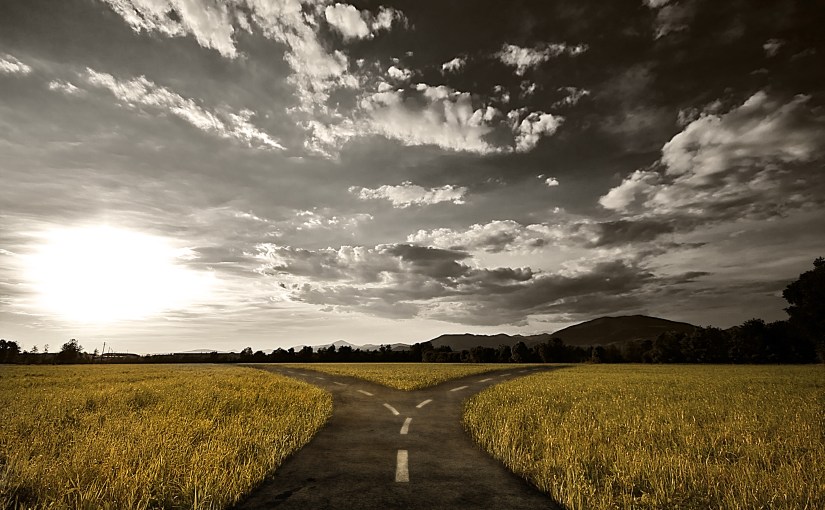
The Challenge Of Choosing Between Bitter And Better
There may only be one letter between bitter and better, but like street signs on the same post, the two words point us in opposite directions. And these signposts are planted firmly, with the same two arrows, at every difficult junction we face on the road of life. No matter how well we may have chosen in the past, or how poorly, the same choice always presents itself all over again: will we let the difficulties of life make us better? Or bitter?
It’s obvious, isn’t it? One choice is literally named “better.” So that’s clearly the choice we’ll always make. Right? Why would we willingly choose to travel a bitter road when a better option is always available to us? The answer is this: we don’t always believe the signposts.
Continue reading The Challenge Of Choosing Between Bitter And Better
Looking Out For Number Two
“Look out for Number One” they say, “if you don’t, no one else will.”
Actually, it wasn’t some generic “they” who said this first, it was Arnold “The Brain” Rothstein. He was boss of the Jewish mob in New York City during the Prohibition era, so I guess you could say he lived it out, too. He certainly took care of himself. He probably took care of a lot of other people as well, if you know what I mean.
Maybe the quote is too vague. There are just so many ways of “looking out” for yourself. Thankfully, most people don’t do it by becoming kingpins. But we still take the kingpin’s advice: Look out for number one. Follow your own bliss. Take care of your own self. After all, The Brain’s logic seems bullet-proof: “if you don’t, no one else will.” Isn’t that how the world works?
Continue reading Looking Out For Number Two
Rivers, Not Lakes
There’s a small lake in our village with a path around it and an island in the middle where a pair of swans make their nest every year. When the cygnets are born, they’re grey and fluffy and clumsy until they grow up and slowly become majestic. Eventually they all fly away and I don’t know where they go. Then every year one couple returns and there’s a new nest and eventually new cygnets.
The cygnets and ducklings and baby coots (cooties?) on the lake make the place a lot nicer to visit, because there are certain times of the year when the water isn’t much of an attraction on its own. It has the typical problem that most small lakes have: it tends to grow green and manky with pondweed and algae and such, especially in the summer. Some summers are worse than others, but even on a good year (like this one) there are still places where the weeds are thick enough that the little cooties can walk around on them instead of swimming.
Continue reading Rivers, Not Lakes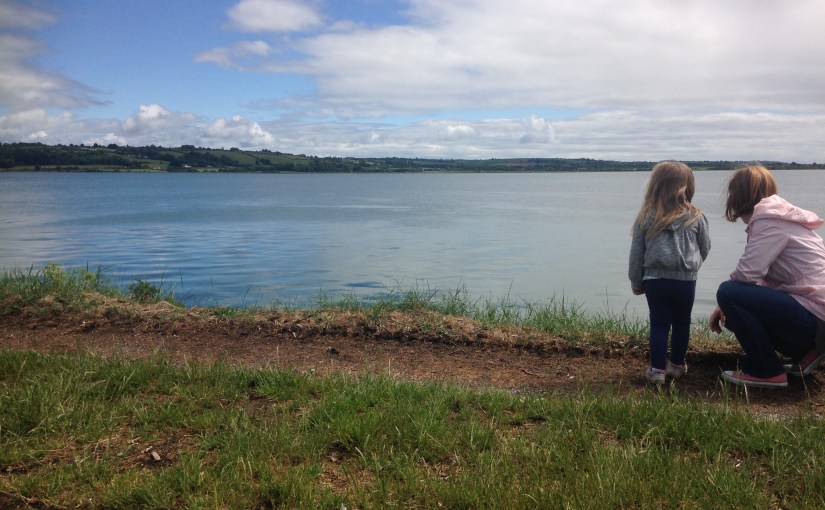
Answering Children
When our children were small, I used to write down some of the things they said because the things they said were so funny and cute. I recorded the most when they were around three and four years old, because that’s the sweet spot when simple logic, creative grammar, and limited vocabulary all come together in fantastically surprising ways. Like the time one of my children asked to see “the belly friend” and I didn’t know who that was but it turned out that the belly friend was the ice cream man—which does make a lot of sense when you think about it. Or when I was asked to pretend that I was real (a question some philosophers would probably love to dig into) or the time one of them asked me to stay with them because they wanted to be alone. Then there was the entrepreneurial child who asked if I’d let him sell our family car for €55 (I didn’t).
Continue reading Answering Children
Days Like Blackberries
It’s blackberry season in Ireland right now, and our family has a yearly tradition of picking them. They’re not hard to find. The vines are growing in the hedges along the roads, reaching out into the paths in the woods, climbing over the old stone walls in the fields, and all of them covering themselves in juicy, plump, sweet little berries. Like candy, except healthier, and with thornier packaging. And free! They just grow, right out of the ground, in loads of public places where we can pick and eat and keep as many as we want. Last weekend we got almost four pounds on one family walk which are now (thanks to my wife) three jars of delicious homemade jam. Can you believe we live in a world where there are jam-bushes growing wild?
Continue reading Days Like Blackberries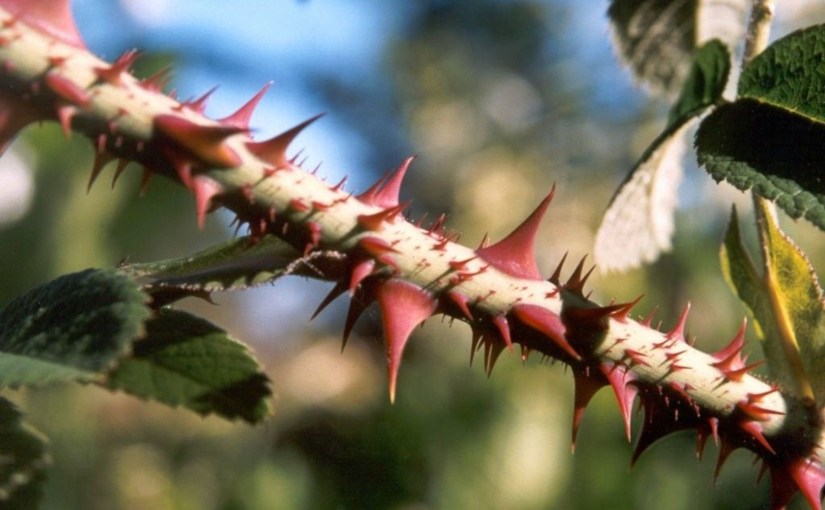
The Weeds (a poem)
You don’t know how bad the weeds are until you try to plant and keep a garden. In a similar way, as C.S. Lewis put it, “no man knows how bad he is till he has tried very hard to be good.” These are the things I was thinking about when I wrote this poem:
Continue reading The Weeds (a poem)
Time-Travel With Care
Time-travelling is one of the standard plot devices of our stories and films, from H.G. Well’s The Time Machine to Interstellar, Dr. Who, The Terminator, and hundreds more. It’s not hard to see the appeal—it’s interesting to imagine what it would be like to visit the world of the future or the past. It’s exciting to think of dipping into a different era, something totally unlike our normal everyday lives here and now. But it’s also easy to see the risks that this kind of time-travelling would bring with it. In the Back To The Future films, Doc Brown gives several stern warnings to Marty about the dangers and potential consequences of interfering with the past. He knows that time-travellers must be aware that even the smallest of actions can change the course of history in surprising ways—as we see in the films.
Continue reading Time-Travel With Care
The Sheep Don’t Know
A cliff rises above the sea, jagged, wild, immovable. The waves, far below, break against it with noisy violence. This is where the ocean ends and the patchwork fields begin, suddenly. In the fields, there are sheep. As I walk past, one of them looks up at me as he chews a disinterested mouthful of grass. He has eyes, so he can see the same view I see. He has ears, so he can hear the waves, and the gulls crying out above him.
I am only visiting, and part of me envies this sheep his home and his everyday sights and sounds. I look up and wonder what the gull’s eyes are seeing as he soars over all of this on the power of the wind. I wonder if I were a gull, could I ever get used to that feeling enough to focus on feeding myself? I think I might be a skinny gull. But I think I would be filled with the thrill of wonder.
Continue reading The Sheep Don’t Know sethlewis.ie