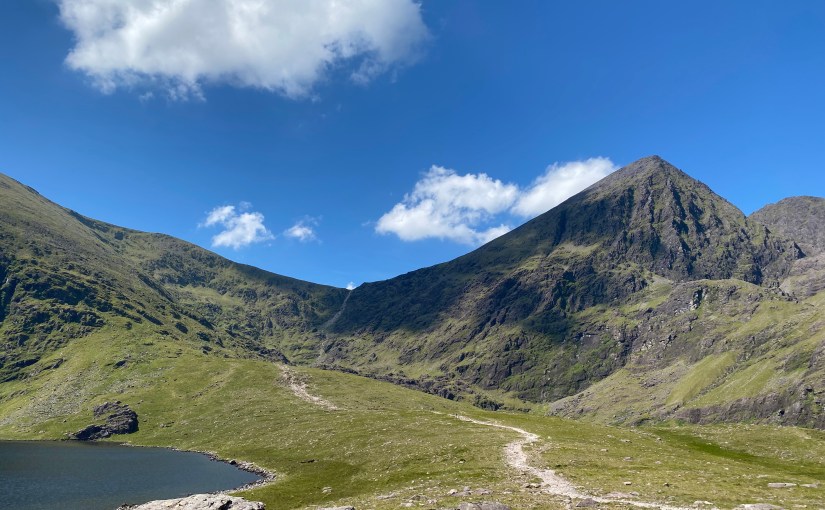
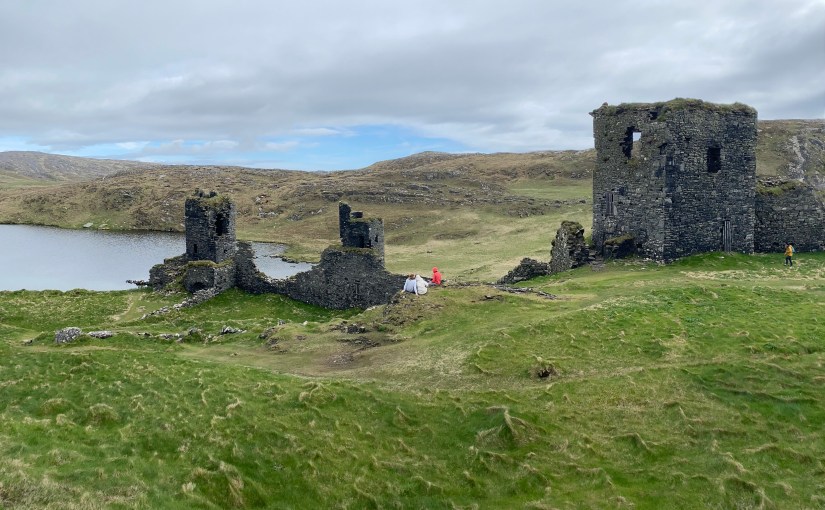
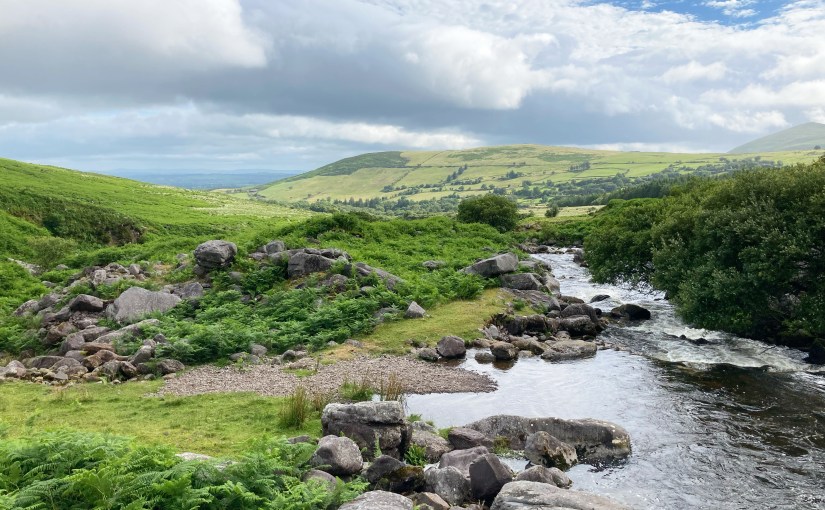
While the children were off school this Easter our family took a trip to explore Mizen Head, the southernmost tip of Ireland. It’s a remote peninsula where the rocky, wild terrain is dotted with cottages of white or pale yellow and the land is a patchwork of squares and rectangles divided by low stone walls. Clusters of sheep and cows surround tiny villages with steeples in the middle and strings of houses and pubs and shops that might be out of eggs if you get there too late. At the southern point where the land runs out there’s an old signal station that’s become a tourist attraction, reached by a footbridge that stretches between impassable sea cliffs. When we walked across and looked down we saw three seals far below us, relaxing in a rocky inlet surrounded by towering, jagged rocks while the seagulls soared above our heads. In the far distance, we could just make out the shape of Fastnet Rock, a tiny island of stone where people managed—somehow—to build a lighthouse to warn those at sea of the ship-shattering dangers around them. At our feet the just-blooming sea-pinks waved in the breeze and I wondered again how these flowers manage—and even seem to prefer—to grow in places where there is so little soil and so much violent wind from the ever-turbulent ocean.
Continue reading The Language of Rivers and StarsTag: God
Changing The Question
Under the cover of darkness, a prominent religious leader sought out the controversial Nazarene that was dividing opinion across the nation. Nicodemus was intrigued by the miracles that Jesus was performing, and wanted to hear more of his teaching. Jesus received him but immediately redirected him, showing Nicodemus that more teaching was not what he needed. What he needed was new life—new birth by God’s Spirit, into life that lasts forever. Nicodemus did not come to Jesus looking for new birth. Jesus did not answer the questions Nicodemus came to ask—he answered the question Nicodemus should have asked. All through the gospels Jesus redirects people’s questions in surprising ways, not only changing the answer from what they expected, but changing the question itself. For example:
Continue reading Changing The QuestionUnthinkable (a poem)
If there was ever a doubt that God can take the evil of this world and turn it into good greater than we can imagine, that doubt was laid to rest when Jesus walked out of the tomb where he had been laid to rest. Humanity killed him for spite, and he died willingly—and rose again to save us. Now he promises that the troubles of his children who trust and follow him will also “work together for good” (Romans 8:28)—but of course that’s not how it feels in the moment when we face the unthinkable.
Unthinkable
Sometimes God allows
The unthinkable
Unbelievable
Thing
To happen
The Indispensable Inefficiency of Prayer
The to-do list is long—it’s always long—and the day only has so many hours. If we want to maximise our time on this planet, we have to prioritise. We can’t do everything, and it’s important to “make the most of every opportunity”, as the apostle Paul tells us in Ephesians 5:16. But what does this mean? How does it look?
For a Christian, one of the most effective uses of our time is an activity that looks to most people—and maybe quite often to ourselves—like one of the most inefficient. And yet, if we really believe what we say we believe, and if we really trust our Saviour to guide us, then it is indispensable:
Prayer.
Continue reading The Indispensable Inefficiency of PrayerA City Whose Builder And Architect Is God
Have you ever noticed that illustrations of heaven tend to lean heavily on Greek architecture? The pillars and spires might be brighter, and the streets paved with gold, but the forms and styles still look familiar. It makes sense—the ancient Greek temples and forums were gorgeous, a true high point of human ingenuity and creativity. But these styles are human conceptions, whereas Hebrews 11:10 tells us that heaven is a city “whose architect and builder is God.”
Have you ever stopped to consider what it looks like when God himself designs and builds a city?
Continue reading A City Whose Builder And Architect Is GodGod Doesn’t Work For Me
“I’m glad you found something that works for you.”
He said it kindly, genuinely happy for me to have found meaning and purpose in my beliefs about God. I said, “Whether or not my beliefs work for me is not the point. I just want to believe what’s true, and live accordingly. I want to know what God is really like—not what I want him to be. My opinion about you doesn’t determine who you really are, and my opinion about God certainly doesn’t change who he is.” God is himself. He is not obligated to work for me—as if my own little self were the centre of all things—he is the centre, and the reason I work at all is because of him. So I’d much rather live in the light of reality, even if it makes me squint, than live in the shadows of my own comfortable delusions.
Continue reading God Doesn’t Work For MeDoodles On A Masterpiece
As I pulled the car into a spot at the edge of the parking garage I saw the sky shine bright blue between the rough block wall and the concrete deck above me. Further down the wall on the right I noticed a tree branch leaning in—green leaves detailed against the grey expanse. Moments before I had been driving under the open sky with living things growing all around, the hills in front and the sea behind me. Now, I was enclosed in a concrete case of re-formed rock, where every earthly material was repurposed beyond recognition. Those materials must have come from nature originally—they had to—but the ways we work with nature are often a stark contrast to the ways nature itself works.
Continue reading Doodles On A MasterpieceAn Elegy For Our Fireplace
When my father built a home for our family in the hills of Alabama he put a large wood stove in the very centre. A good fire in that stove could heat the entire house, upstairs and down, for most of the night. I grew up splitting logs and carrying them in, building fires and learning to finesse small sparks into roaring warmth. They say firewood warms you twice, and it’s true—first when you cut it, and again when you burn it. The sound of our fire sucking air through the stove vents like breath, the crackling wood, the reassuring smoke from the chimney as I headed in from the winter cold—all are essential pieces of my childhood, baked into my soul by the power of the flames.
Continue reading An Elegy For Our FireplaceA Christmas Selection Box 2024
One of the standard features of Christmas in Ireland is the chocolate selection box. It’s a great tradition—who wouldn’t like a box filled with a variety of different chocolates to enjoy over the holidays? I can’t give you chocolate today, but I’ve made it a tradition to collect and share a variety of Christmas treats every December from around the internet. Enjoy!
Continue reading A Christmas Selection Box 2024How To Avoid A Midlife Crisis (an open letter to twenty-somethings)
Dear young adult,
I know you’re not thinking about having a midlife crisis right now. I know the concept feels far away and foreign, the domain of grumpy gen-Xers and geriatric millennials who drink too much coffee and still complain about being tired all the time. I know you’re probably tired of people telling you to enjoy your stage of life because it all goes so fast. You might not believe me, but the reason almost everyone says this when they reach a certain age is because stages of life actually do go quickly. In fact I can prophecy with confidence that you’ll be saying the something similar in about twenty years time, to the tolerant nods of your juniors. Twenty years probably feels like an eternity to you right now. I get it. But eventually the speed of life catches up with you like a marathon runner who loses sight of the starting line and suddenly realises that the impossibly-distant finish line is actually real and not so distant after all. The difference is that a marathon runner wants to reach the finish line, whereas in life most people don’t. Thus, the midlife crisis. And apparently, I’m due for one. I’ve slept through enough nights and celebrated enough birthdays to qualify for such things, even though no one can tell me what the true mid-point of my life is with any degree of certainty. The specifics don’t matter. My life is clearly passing by, and I’ve reached the stage where this fact can no longer be hidden or ignored. This is the driving force of the midlife crisis—the sudden intrusion of truths we like to push away for as long as possible. At some point they come in anyway, and make themselves at home.
Continue reading How To Avoid A Midlife Crisis (an open letter to twenty-somethings)