The car windows were open, and Carlos Santana was making his guitar sing out of our stereo in ways that few can imitate. With the wind in her hair, my wife commented from the passenger seat that she reckoned people who play guitar probably appreciate his solos more than she could. She’s an experienced musician herself, but her instrument is piano. I play guitar—but I wouldn’t claim such a thing in front of Carlos. Still, even my amateur knowledge makes me see the truth in what my wife said. I’ve tried to learn my scales and unlock the hidden order of the fretboard and train my fingers to move freely along it—and I have not succeeded. When I hear someone whose mastery of the instrument is as complete as Santana’s, I think my own attempts—as small as they are—really do make me appreciate his abilities in a different way. My limited experience with the instrument gives me the beginnings of a context for the kind of work he must have put in day after day and year after year to develop his seemingly effortless (yet in reality hard won) talent. I’d imagine if I was more accomplished at guitar myself, I would appreciate the skill of masters like Santana even more. As my knowledge of music grows, my appreciation grows along with it.
Continue reading Appreciation Grows With KnowledgeTag: faith
Realism And Resurrection
Perhaps it’s a product of growing up, but I do feel that the passing years have tarnished the old optimism I remember from the world of my childhood. There were always deep problems in the world—even I knew this growing up—but there was also a general sense of progress in the air, at least as I remember it. There was a hopeful feeling back then that our problems were not insurmountable, and better days were ahead. Science was supposed to solve some of our challenges, politics would solve others, and culture and civilisation would inevitably advance, even if the process was slow and bumpy. Those were the days when the unified, peaceful vision of a harmonious humanity depicted in shows like Star Trek felt like it could be a real possibility someday—minus the teleporters, of course.
Now we’re not so sure. The world feels different. Maybe our new technologies haven’t been all that we hoped they would be. Maybe our political leaders have burned us too many times and left us disillusioned with the system. Wars have continued relentlessly, as have human trafficking and slavery and corruption. Selfishness, injustice, and cruelty still plague our cultures and institutions, and they can pop up unexpectedly in our own hearts, too. Things are still moving quickly, but it’s become clear that movement isn’t necessarily progress. The old optimism of my memory has given way to a tired realism that doesn’t expect as much, hope as much, or feel as disappointed when everything goes sideways—isn’t the whole world constantly spinning sideways anyway?
Continue reading Realism And Resurrection
Inheriting Righteousness
Have you ever thought about how much you’ve inherited from others? Your life is inherited, to begin with. Your way of life is inherited as well, from those who have gone before you and built up the world to be what it is—who developed the technologies, coordinated the supply chains, and built the infrastructure that shapes our daily lives. Most of the knowledge we learn in school was passed down from the generations before us, as are many of our recipes, our holiday traditions, and our sports. And of course there are bad things, too, like predisposition to diseases, cultural blind spots, broken systems, and so much more. For good or bad, our lives are profoundly shaped by all that we have inherited. Profoundly, but not completely.
Continue reading Inheriting Righteousness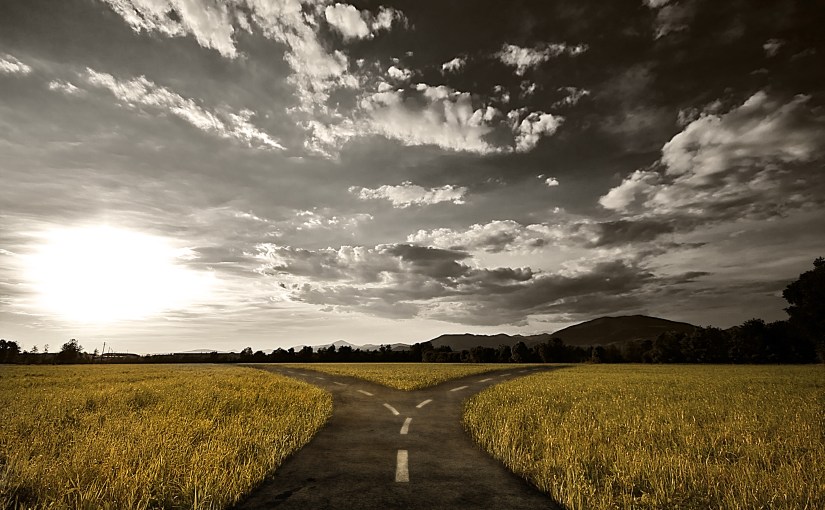
The Challenge Of Choosing Between Bitter And Better
There may only be one letter between bitter and better, but like street signs on the same post, the two words point us in opposite directions. And these signposts are planted firmly, with the same two arrows, at every difficult junction we face on the road of life. No matter how well we may have chosen in the past, or how poorly, the same choice always presents itself all over again: will we let the difficulties of life make us better? Or bitter?
It’s obvious, isn’t it? One choice is literally named “better.” So that’s clearly the choice we’ll always make. Right? Why would we willingly choose to travel a bitter road when a better option is always available to us? The answer is this: we don’t always believe the signposts.
Continue reading The Challenge Of Choosing Between Bitter And Better
The Key To Understanding The Bible
The Bible is the most influential book in history. No other book comes close to its print numbers, translations, or the number of lives and even cultures that have been radically changed by it. The message is more important, and more transformative, than anything ever written before or since. But although this book is the ultimate best-selling, world-shaping classic of literature, it can’t be fully understood if it is read like other books. It is not one more textbook to study, or history to appreciate, or how-to guide to follow. It is unique: it is God’s revelation of who he is and what he has done, and of who we are and what our lives are for. It does not present us with a religious or philosophical system to assent to, it presents us with a personal God to respond to. Reading it, hearing sermons about it, and studying it are all great things to do, but if you really want to understand the Bible, it’s not enough to listen to it. You have to respond to it. You have to obey it.
Continue reading The Key To Understanding The Bible
Wade In The Water
In 1998, Eva Cassidy recorded an old spiritual called “Wade in the water”. I was listening to her sing it in my car just recently:
Wade in the water
Wade in the water, children
Wade in the water
God’s gonna trouble the water
The lyrics are simple, but this water runs deep. As you’d expect from a spiritual, the reference is biblical. The rest of the song speaks of the children of Israel on the banks of the Jordan river, ready to cross into the promised land. In Joshua chapter 3, God tells the priests of Israel to carry the ark of the covenant, the symbol of his relationship with his people and presence with them, to the edge of the flooded river and stand in the water. They obeyed, and as soon as their feet got wet, God began to stop the flow of a mighty river and clear a path for his people to walk across on dry land.
Continue reading Wade In The Water
A Girl And Her Balloon
When you have three children under ten, there’s no point taking a vote on where to go out to eat. You’ll be outnumbered, and there’s only one option in this area that offers the triple crown of childhood meals: nuggets, toy, and balloon – it’s going to be McDonald’s. This was our reality at the beginning of 2016, so after an event in the city one weekend, we made tracks for the Golden Arches. I don’t remember the toy that day (most of those things are forgotten by everyone a few nanoseconds after we get home, only to be rediscovered later inside the couch or under a seat in the car), but I’ll never forget Rebekah’s balloon. She picked it out before the meal, carefully selecting the pink one for herself, distinct from the blue and green of her brothers. She ate next to it happily, and played with her toy. Then we got up to leave, walked out the door, and when she spotted the sky, her eyes lit up. She held her balloon as high as she could and stood up on her toes… but something was wrong. A cloud of disappointment moved over her sunny smile:
“I thought it would make me go up”
 sethlewis.ie