An Elegy For Our Fireplace

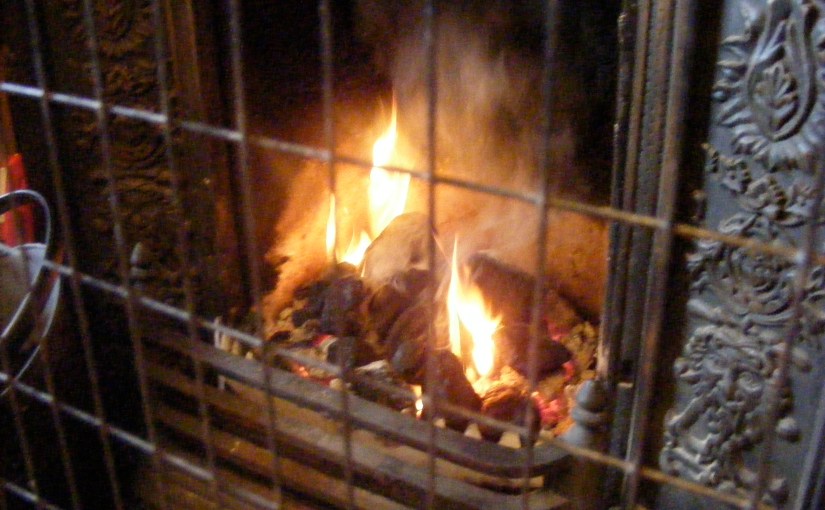
When my father built a home for our family in the hills of Alabama he put a large wood stove in the very centre. A good fire in that stove could heat the entire house, upstairs and down, for most of the night. I grew up splitting logs and carrying them in, building fires and learning to finesse small sparks into roaring warmth. They say firewood warms you twice, and it’s true—first when you cut it, and again when you burn it. The sound of our fire sucking air through the stove vents like breath, the crackling wood, the reassuring smoke from the chimney as I headed in from the winter cold—all are essential pieces of my childhood, baked into my soul by the power of the flames.

Continue reading An Elegy For Our Fireplace

What Makes Our Town (Or Any Place) Great

What makes a town or a city a great place to live? There are many factors, of course, from cost of living to amenities and natural beauty and so on, but there is one factor that surpasses them all. This was pointed out to me by a man who has been dead for some time, G.K. Chesterton. He wrote about what makes cities great in his often surprising and famously thought-provoking testimonial work, Orthodoxy. Using Pimlico as an example—a village in central London which must have been dire in Chesterton’s time—he says:

“Let us suppose we are confronted with a desperate thing—say Pimlico…. It is not enough for a man to disapprove of Pimlico: in that case he will merely cut his throat or move to Chelsea. Nor, certainly, is it enough for a man to approve of Pimlico: for then it will remain Pimlico, which would be awful. The only way out of it seems to be for somebody to love Pimlico: to love it with a transcendental tie and without any earthly reason. If there arose a man who loved Pimlico, then Pimlico would rise into ivory towers and golden pinnacles; Pimlico would attire herself as a woman does when she is loved… If men loved Pimlico as mothers love children, arbitrarily, because it is theirs, Pimlico in a year or two might be fairer than Florence. Some readers will say that this is a mere fantasy. I answer that this is the actual history of mankind. This, as a fact, is how cities did grow great… Men did not love Rome because she was great. She was great because they had loved her.”

Continue reading What Makes Our Town (Or Any Place) Great

A Fan

There is a simple machine in our house that gives me more happiness than is really logical or reasonable. Most of the year, it lives in the attic, waiting for the summer when the house warms up and we open the windows to let the breeze in (this is the only air conditioning system we need in Ireland). To help encourage that summer breeze inside, we take down the fan from storage and turn it on. I enjoy turning on the fan more than I can sensibly explain to you. I guess you could say I’m a fan of it. The sound of the motor and spinning blades resonates with something deep inside of me, which is strange, I know, but the breeze dusts off long-past memories of summer days and the places I used to spend them. In that mental swirl there arises an old and comfortable happiness, intangible but very real, and I can’t help but smile. 

Continue reading A Fan

The Crooked Apple Tree

Beside a country road in Ireland there are two tall pillars marking the entrance to my friend’s home, down a lane that used to lead to a massive manor house. That mansion is long gone, but the stately pillars remain as crumbling reminders of its past glories. The gravel lane between them now winds its way to the old farm buildings on the estate, which were nothing but ruined walls until my friend rebuilt them into a home. Outside, the chickens wander freely with the dogs among the garden beds and fruit trees. 

Continue reading The Crooked Apple Tree

Pruning (a poem)

Everything grows fast in the garden this time of year. The rose stems stretch themselves upward, then droop with the weight of their own blooms. The grape vine climbs the arbour, blindly grasping anything it can hold on to. The weeds come back, and come back again, from somewhere, everywhere, while the vines on the back wall grow in every direction at once. All of this growth is a beautiful, abundant gift, yet I know that if I leave it untended for too long, my garden will eventually become something else entirely. The strawberries will send runners into the grass, the grass will colonise the herb bed, the weeds will colonise the grass, and the roses will block the path with thorns. The longer I leave it alone, the harder I’ll have to work to reclaim it. And here, in the wild tendencies of my garden, I see a reflection of myself. That’s what this poem is about:

Continue reading Pruning (a poem)

All Of It, All At Once

There was still an hour before I had to be at my first meeting for the day. The morning was beautiful, promising to be one of the nicest days of the year. I had to go outside. I didn’t know the area, but my phone told me there was a park in a nearby town I’d never been to. A few minutes later, I pulled in next to the jogger and dog-walker sedans—the family cars hadn’t arrived yet. The park was extensive. It was build around a lake, with ancient trees and well-maintained lawns, meandering paths, benches, swans, and the dawn chorus echoing in stereo surround-sound all around me. 

Continue reading All Of It, All At Once

The Secret Of Contentment

When I see the ruins of old cottages around us in Ireland, I’m always struck by how small they are, and by how dramatically our everyday living has changed. Even the best of the ancient castles are not nearly as comfortable as a standard modern home or apartment. They didn’t have flushing toilets. They didn’t have radiators or refrigerators or wifi. They didn’t have washing machines or cars or exotic foods from around the world available year round in local shops. They couldn’t order whatever they wanted from anywhere and have it shipped to their door in days without ever needing to leave the climate-controlled comfort of their own couch. If our ancestors could see us now, they would probably expect us to be the happiest, most care-free and content people to ever live. And they would be wrong. Our modern society is anything but content. We are plagued by anxiety, depression, relational breakdown, hopelessness, and despair. We promote mental health now more than ever, but the problems persist, and grow. Clearly, contentment is not just the result of having more wealth, more opportunities, more education, or better conditions. If it were, we should be one of the most content societies to ever live on planet earth. And yet somehow, contentment has eluded us. Have we been looking for it in the wrong places?

Continue reading The Secret Of Contentment

Patrick Loved Ireland Before Ireland Loved Patrick

On the 17th of March, people around the world will celebrate Ireland’s national holiday, St. Patrick’s Day. Is there any other national holiday in the world that is celebrated as internationally as Ireland’s? It is truly unique. So as the bunting goes up and the landmarks turn green and the parades are organised, it’s worth remembering the man who inspired this global celebration. 

Like the holiday named after him, Patrick’s life was truly unique. He did not consider himself a great man, and would likely be uncomfortable with the extravagance of the yearly honours we bestow on him. In his autobiography, he calls himself “a simple country person, a refugee, and unlearned.” The reason he calls himself a “refugee” is because his connection with Ireland, which is how everyone remembers him today, only began when he was sixteen—and it wasn’t a good start at all. The first Irish people that Patrick met were the people who raided his hometown (probably in Wales) and carried off thousands of prisoners—including Patrick—to be sold into slavery in Ireland. Our patron saint’s first sighting of Ireland’s beautiful shores came while he was in the chains of human traffickers. In Ireland, Patrick tells us that he was “brought low by hunger and nakedness daily.” His slavery continued until he was twenty-two years old. This is not the part of the story we celebrate on March 17th.

Continue reading Patrick Loved Ireland Before Ireland Loved Patrick

How I’m Voting In The Constitutional Referendum (And Why)

On the 8th of March, the citizens of Ireland will be asked to make two changes to our constitution by referendum. Because of the importance of these decisions, I’d like to use this week’s post to discuss them. The first change would be to the constitutional definition of the family, adding “other durable relationships” alongside marriage in Article 41. The Article with the proposed change would read this way (updated wording in bold):

Article 41.1.1° “The State recognises the Family, whether founded on marriage or on other durable relationships, as the natural primary and fundamental unit group of Society, and as a moral institution possessing inalienable and imprescriptible rights, antecedent and superior to all positive law.”

Continue reading How I’m Voting In The Constitutional Referendum (And Why)

Another Chance (a poem)

It’s been months since I paid any attention to the long-lost autumn leaves that are lying in the grass alongside the roads and paths that I walk on. The glorious colour they impressed me with when they fell is nothing but a memory now. Then again, have you seen what frost can do to a leaf on the ground? This morning, every vein of every leaf is highlighted in white—the intricate patterns stand out in shimmering relief—and once again my eyes are drawn in renewed wonder. A few weeks ago, I would have told you that these leaves were far beyond their glory days. This morning, they shine unexpectedly with a new and different kind of glory. Our Creator can make beauty shine from a pile of dead leaves, and anywhere he wants, and long after we’ve given up hope of it ever coming again.

Continue reading Another Chance (a poem)