I Miss The Stars

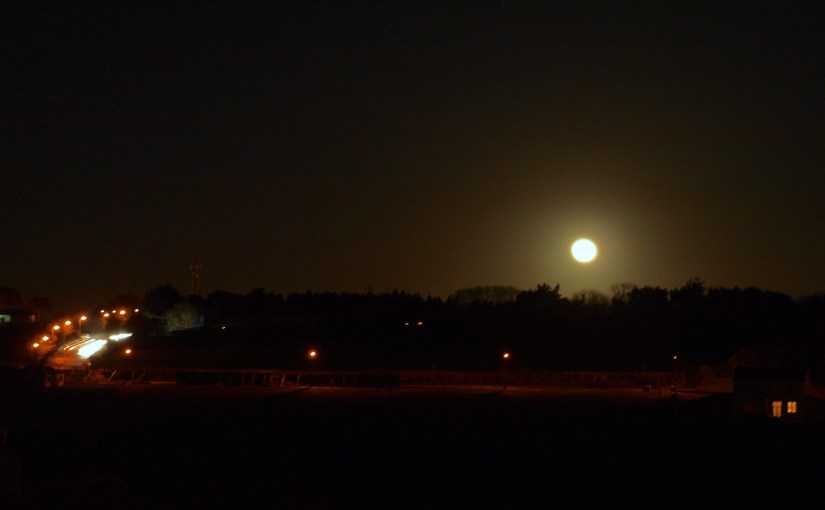
One of the advantages of growing up in the country in Alabama was the clear view I had of the night sky. As a child, I got used to seeing billions, maybe trillions of stars—I don’t really know, there were far too many to count. Stars were a given for me, along with the noisy nighttime chorus of cicadas, crickets and frogs. Now I live in Ireland, where most nights the clouds pull themselves over me like a duvet. Under these covers my town is equipped with rows of man-made lights that imitate and compete with the stars, so even when the duvet is lifted, I might—on a good night—be able to count a dozen stars. But I know better. I know what’s really out there in those seemingly dark, empty spaces—I’ve seen it with my own eyes. I remember the sparkling host, the glittering crowd, the innumerable army of light with its clustered regiments and flag-bearing constellations. Can I be honest? I miss them.

Continue reading I Miss The Stars

Three Castle Head

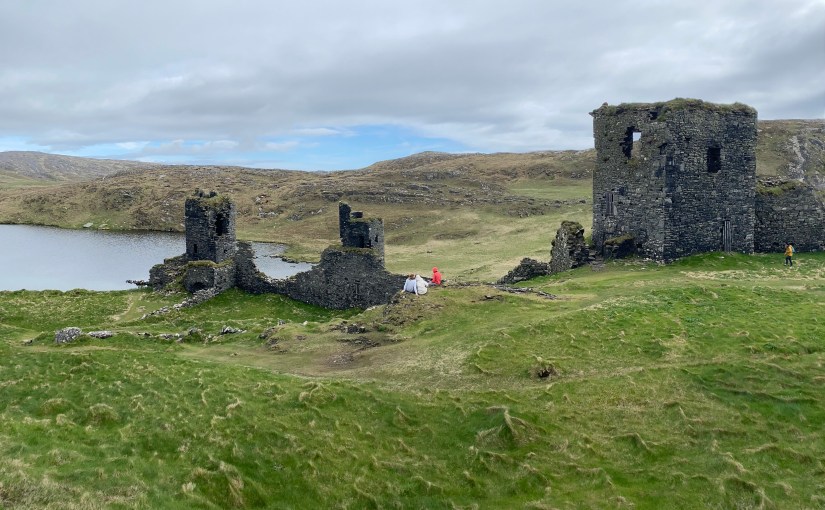
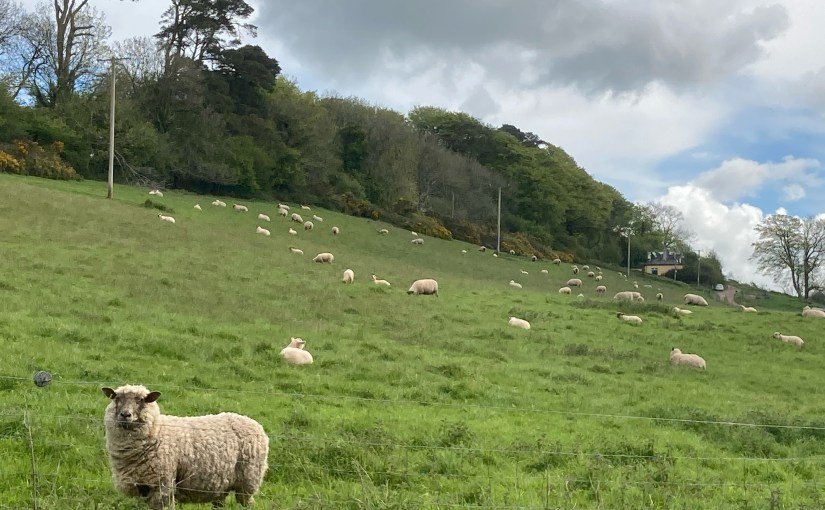
On a sunny day in the Spring, we pulled the car into a gravel parking area at the end of a remote peninsula in Ireland. The sea shimmered in the light beyond the deep green fields lined and dotted with grey rock walls and white sheep. We opened the gate and crossed a field, and then another, and another, carefully following the faint paths worn by the feet of those who had come here before us. Sometimes we had to make a choice—it seems not all of our predecessors had gone the same way. Or did hooves make one trail, and feet another? Eventually the grassy fields gave way to rocky hills, and we scrambled up one side and down the other where the grass and mud and boulders and the sound of the sea all blend together into a kind of otherworldly magic and I had to remind myself that I wasn’t looking at an illustration of the Wild Lands of Narnia—I was in the real, tangible, wild of the actual world.

Continue reading Three Castle Head

I Don’t Know Where The Streams Are

One warm Monday evening, I found myself with half an hour to fill as I waited for one of my children to have a music lesson. Across the street was a new greenway, quietly inviting me to spend the time strolling instead of scrolling. The path passed along roads I’d travelled many times in the car, so I didn’t expect to see anything new, just to stretch my legs. I was wrong.

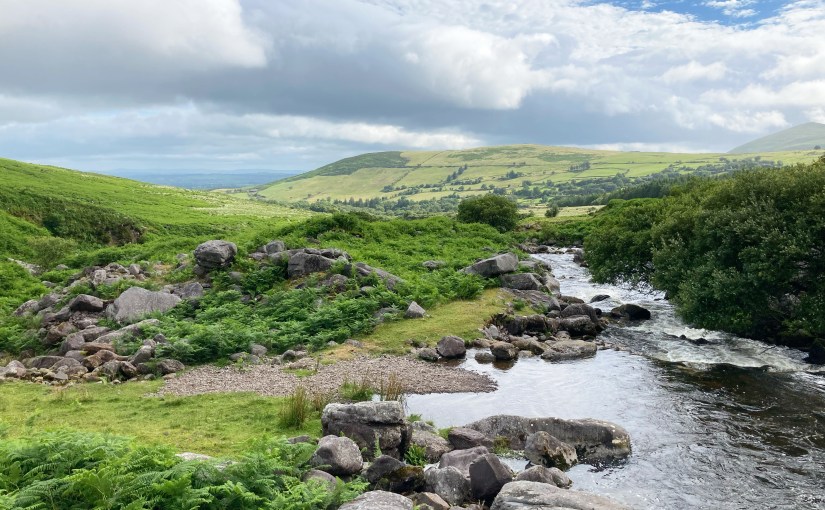
Things look different when you’re walking. You have time to notice the individual wildflowers, and the meadow behind the wall with the horses in it that you just couldn’t see from the driver’s seat of the car. The discovery that surprised me most, though, was the stream running right beside the road. Through the crowded trees and bushes it babbles away constantly as it splashes its way over rocks and under roots and how did I travel this road so many times and never even know this was here?

Continue reading I Don’t Know Where The Streams Are

The Language of Rivers and Stars

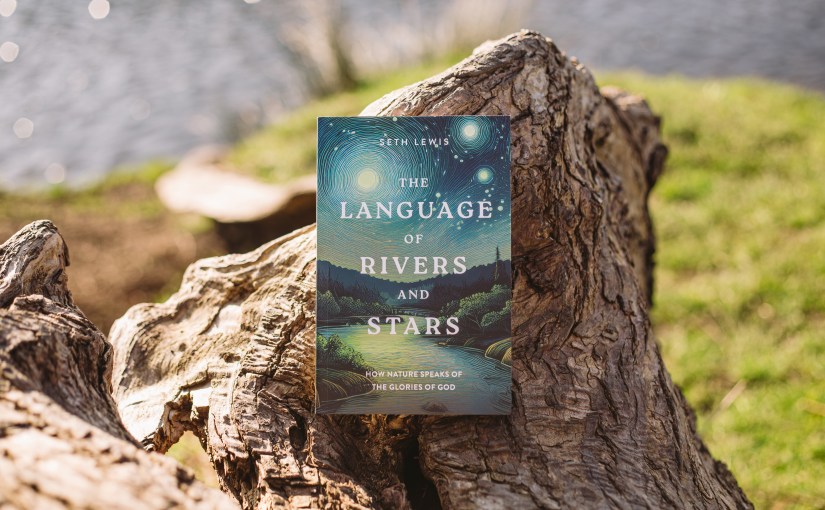
While the children were off school this Easter our family took a trip to explore Mizen Head, the southernmost tip of Ireland. It’s a remote peninsula where the rocky, wild terrain is dotted with cottages of white or pale yellow and the land is a patchwork of squares and rectangles divided by low stone walls. Clusters of sheep and cows surround tiny villages with steeples in the middle and strings of houses and pubs and shops that might be out of eggs if you get there too late. At the southern point where the land runs out there’s an old signal station that’s become a tourist attraction, reached by a footbridge that stretches between impassable sea cliffs. When we walked across and looked down we saw three seals far below us, relaxing in a rocky inlet surrounded by towering, jagged rocks while the seagulls soared above our heads. In the far distance, we could just make out the shape of Fastnet Rock, a tiny island of stone where people managed—somehow—to build a lighthouse to warn those at sea of the ship-shattering dangers around them. At our feet the just-blooming sea-pinks waved in the breeze and I wondered again how these flowers manage—and even seem to prefer—to grow in places where there is so little soil and so much violent wind from the ever-turbulent ocean.

Continue reading The Language of Rivers and Stars

Transplanted

There’s an old Regency manor house near us that has been preserved as a heritage site, beautifully surrounded by manicured gardens that are faithfully tended by volunteers and open to the public. The gardens were planted and arranged over successive generations in the old English style—which means that the plants and trees were imported from all across the globe. This worked particularly well on the Fota estate because of its sheltered conditions. Even its name, Fota, is derived from the Irish “Fód te”, meaning “warm soil”. The arboretum is particularly impressive, boasting some of the finest specimens of pine, cypress and sequoia in Europe. There are also acers and eucalyptus, tasmanian tree ferns, acacia and magnolias that burst open with enormous flowers before the leaves even begin to appear. A walk through Fota gardens is a walk around the world, with the sights, smells, and colours of the Himalayas, Japan, Chile, China, New Zealand, the Pacific Northwest, and beyond.

Sometimes I’ve wondered how trees from California and Australia can grow so well in Ireland. I suppose they don’t have much of a choice in the matter, but they’ve certainly made the best of it. Their roots are deep in the fód te, and I have to strain my eyes to see some of their towering tops. They have not simply survived in a foreign land. They have made it their home, and thrived. When I wander among them, I am encouraged.

Continue reading Transplanted
An Elegy For Our Fireplace

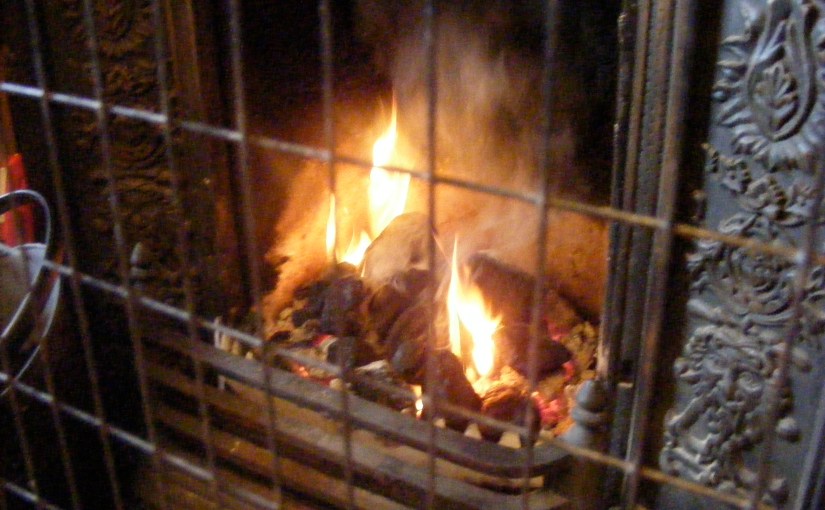
When my father built a home for our family in the hills of Alabama he put a large wood stove in the very centre. A good fire in that stove could heat the entire house, upstairs and down, for most of the night. I grew up splitting logs and carrying them in, building fires and learning to finesse small sparks into roaring warmth. They say firewood warms you twice, and it’s true—first when you cut it, and again when you burn it. The sound of our fire sucking air through the stove vents like breath, the crackling wood, the reassuring smoke from the chimney as I headed in from the winter cold—all are essential pieces of my childhood, baked into my soul by the power of the flames.

Continue reading An Elegy For Our Fireplace

A Christmas Selection Box 2024

One of the standard features of Christmas in Ireland is the chocolate selection box. It’s a great tradition—who wouldn’t like a box filled with a variety of different chocolates to enjoy over the holidays? I can’t give you chocolate today, but I’ve made it a tradition to collect and share a variety of Christmas treats every December from around the internet. Enjoy!

Continue reading A Christmas Selection Box 2024

The (Unimpressive) Ambassadors Of Heaven

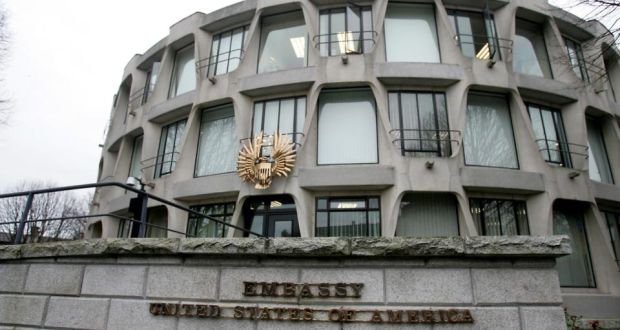
The American Embassy in Ireland is a big building, but the public (even the American ex-pat public) can only see a small part of it. That part is mostly security guards, fluorescent lights, and bulletproof glass. Somewhere inside of the building I know there’s a ballroom. If I was a Very Important Person I might get to see it, and maybe I’d even meet the ambassador herself. America’s ambassador to Ireland has a very impressive list of credentials, which is to be expected. Nations that are great and powerful (or want to be perceived that way) do their best to be represented by highly qualified individuals who are skilled in the diplomatic arts. People who can make a good impression at fancy dinners in ballrooms with VIPs. People who can move their nation’s interests forward through the ever-changing minefield of political realities.

Continue reading The (Unimpressive) Ambassadors Of Heaven

Assisted Suicide And The Meaning Of Life

Our representatives in Dublin are voting this evening on whether to approve recommendations for assisted suicide in Ireland. This is only an indicative vote, a first step towards changing our laws, but it is a step that will pave the way for official legislation to be brought forward in the future. The argument in favour of this change is usually framed in the language of compassion and choice—that those who are suffering greatly should be able to end their suffering—and their lives—on their own terms. There are, however, many significant concerns raised in the debate as well. For example, there is the unspoken (or perhaps spoken) pressure to die that allowing this option places on good-hearted people who hate to be a burden on others. Is that really a free choice? Or consider the obvious cost-cutting incentive that assisted suicide gives the health service to end lives rather than provide expensive palliative care. Does that really promote compassion? These concerns are reason enough to oppose assisted suicide, especially in light of the heartbreaking evidence from countries who have already started down this road. But I have another more fundamental objection. I know that the one great benefit and argument for assisted suicide is that it ends suffering. This is true enough. The trouble is that it ends suffering not by treating or managing it, but rather by ending the sufferer. In doing so, assisted suicide creates a new category for our culture—a category of human life that society agrees is simply not worth living. 

Continue reading Assisted Suicide And The Meaning Of Life

What Makes Our Town (Or Any Place) Great

What makes a town or a city a great place to live? There are many factors, of course, from cost of living to amenities and natural beauty and so on, but there is one factor that surpasses them all. This was pointed out to me by a man who has been dead for some time, G.K. Chesterton. He wrote about what makes cities great in his often surprising and famously thought-provoking testimonial work, Orthodoxy. Using Pimlico as an example—a village in central London which must have been dire in Chesterton’s time—he says:

“Let us suppose we are confronted with a desperate thing—say Pimlico…. It is not enough for a man to disapprove of Pimlico: in that case he will merely cut his throat or move to Chelsea. Nor, certainly, is it enough for a man to approve of Pimlico: for then it will remain Pimlico, which would be awful. The only way out of it seems to be for somebody to love Pimlico: to love it with a transcendental tie and without any earthly reason. If there arose a man who loved Pimlico, then Pimlico would rise into ivory towers and golden pinnacles; Pimlico would attire herself as a woman does when she is loved… If men loved Pimlico as mothers love children, arbitrarily, because it is theirs, Pimlico in a year or two might be fairer than Florence. Some readers will say that this is a mere fantasy. I answer that this is the actual history of mankind. This, as a fact, is how cities did grow great… Men did not love Rome because she was great. She was great because they had loved her.”

Continue reading What Makes Our Town (Or Any Place) Great