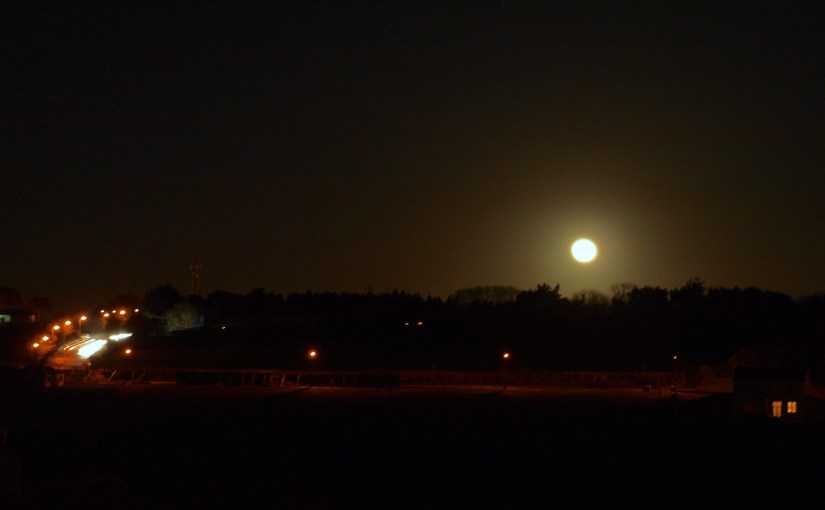
One of the advantages of growing up in the country in Alabama was the clear view I had of the night sky. As a child, I got used to seeing billions, maybe trillions of stars—I don’t really know, there were far too many to count. Stars were a given for me, along with the noisy nighttime chorus of cicadas, crickets and frogs. Now I live in Ireland, where most nights the clouds pull themselves over me like a duvet. Under these covers my town is equipped with rows of man-made lights that imitate and compete with the stars, so even when the duvet is lifted, I might—on a good night—be able to count a dozen stars. But I know better. I know what’s really out there in those seemingly dark, empty spaces—I’ve seen it with my own eyes. I remember the sparkling host, the glittering crowd, the innumerable army of light with its clustered regiments and flag-bearing constellations. Can I be honest? I miss them.
I should not be able to count the stars on a clear night. It should not be possible. Stars were never meant to be countable. They’re meant to overwhelm us, to remind us of how big the universe is and how small we are down here on our wet little garden rock. They’re meant to “declare the glory of God” (Psalm 19) and make us wonder, like King David, “what is man, that you are mindful of him?” (Psalm 8), and marvel that he really is mindful of us. The few pinpricks of light I see are not very overwhelming, but I still find them useful. I use them to pin up the map of remembered majesty in my head. I start from what I have and fill in the empty gaps between them, reminding myself of all the invisible realities I’m no longer able to observe. It’s better than nothing. But it still makes me sad. Isn’t it odd that we, who know far more about the universe than any of our ancestors, actually see far less of it?
We’ve erased so much of the wonder from the night sky, drowning it in the haze of our electric imitations. I know we can’t go back. It’s too late for that, and I really am thankful for electricity. But we ought to at least recognise the loss. I’m convinced it’s a bigger loss than we think. Disconnecting ourselves from the grandeur of the universe inside our cozy little light-up cocoons is a dangerous position to put ourselves in. We could forget what the world is. We could forget what we are. We could forget our Maker. Being able to count the stars feels like a metaphor for all the ways we distract ourselves from God’s overwhelming glory with all manner of clever little haze-inducing imitations. We do it all the time. And yet, for all that, reality remains.
Don’t let the streetlights blind you.
 sethlewis.ie
I grew up in the country, too. My friends and I would lie in the grass looking up at the night sky through the trees, “shhh, don’t count out loud, you’re messing me up.”
As of now, here in the low desert of Arizona, I can’t count the stars. But, it’s creeping in on me. More lights on the horizon. A power plant being built between me and my mountain.
It won’t be long.
LikeLiked by 1 person
Enjoy them! And hopefully even when the lights encroach, there will be somewhere you can go to see them better. They are such a gift.
LikeLike
I grew up in the country, too. My friends and I would lie in the grass looking up at the night sky through the trees, “shhh, don’t count out loud, you’re messing me up.”
As of now, here in the low desert of Arizona, I can’t count the stars. But, it’s creeping in on me. More lights on the horizon. A power plant being built between me and my mountain.
It won’t be long.
LikeLike