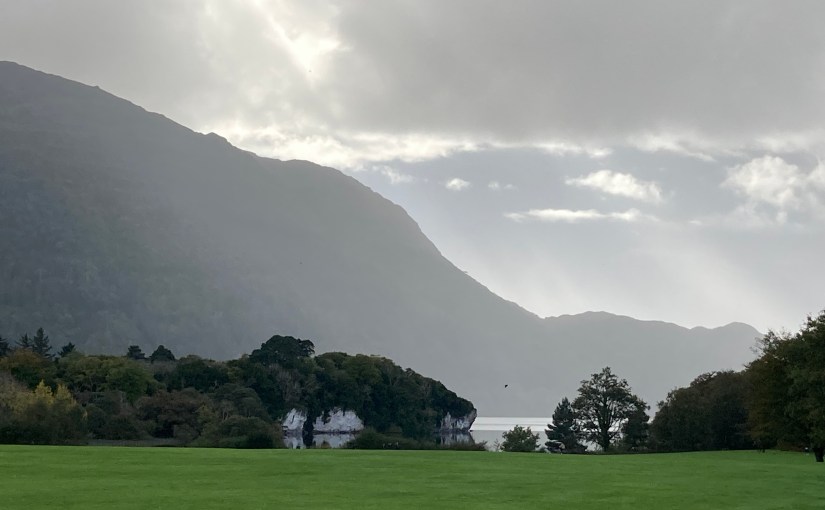
It was a Sunday afternoon in Killarney, and I was alone with no time pressure. In a situation like that, there’s no difficulty in knowing where to go—it has to be Killarney National Park. The paths are basically endless there, winding as they do through the mature forests that grow along the lakeshore and up into the mountains. The fields, the ruins, and the trees all have long histories, histories that bleed their weight and significance into the air and make quick steps—like mine—ring with impertinence.
My manners were mended when I was forced to step aside from the main path in deference for a horse that was pulling a jaunting car. As I waited, I noticed a narrow track worn into the ground at the very edge of the lake. This new way called to me with the eternal appeal of the road less travelled, and I was not disobedient. There were no horses on that tiny trail, and no other people, either. The sound of my own heavy feet on the ground was all I heard, accompanied by the occasional rustle of the leaves above me and the endless quiet splashing of rippled water against ragged outcroppings of rocks and roots beside me. When I stopped my noisy shoes on a protruding boulder, the stillness immediately enveloped me.
From my boulder (I do realise that my squatter’s claim to that rock was only temporary, like every claim I make in this world), I could see that the far side of the lake was forested as much as my own. Above the tree-line were the outlines of hills and mountains, rising in the distance. In all of this natural beauty, only one man-made structure was visible: a church steeple. Its colour, faded by distance, was the same as the hills around it, but its shape was unmistakable. When I saw that lone steeple rising above the trees, I remembered why our ancestors went out of their way to build such narrow towers on their churches. It was an arrow, directing my eyes to heaven. Just as it was made to do.
Some distance to the left, the mountains rose higher—far higher—dwarfing the size of the little man-made steeple-arrow. And yet, seeing the two together in such close proximity, it struck me that both steeples and mountains can serve the same spiritual purpose. The mountains also have a Maker, after all, and isn’t it possible that He made their peaks pointed for the same reason? Are they not arrows, pointing to heaven? The Psalmists sang of such things, long ago:
“I lift up my eyes to the mountains—
where does my help come from?
My help comes from the Lord,
the Maker of heaven and earth.”
– Psalm 121:1-2
In the vast, open cathedral of nature, God’s mountains are the steeples. Far above the abilities of human architects or builders, they rise, but not for their own glory—their very shape points beyond themselves, beyond their own majesty and strength and awe-inspiring beauty. They direct our attention upward—to the heavens, to the Maker of the heavens and the mountains and all things. As church steeples, by their shape and architecture, remind us of God and call us silently to worship and trust him, so too the mountains. If you see one of them today, let its strong, stone arrow direct your eyes, and your heart, to the Maker of heaven and earth.
 sethlewis.ie