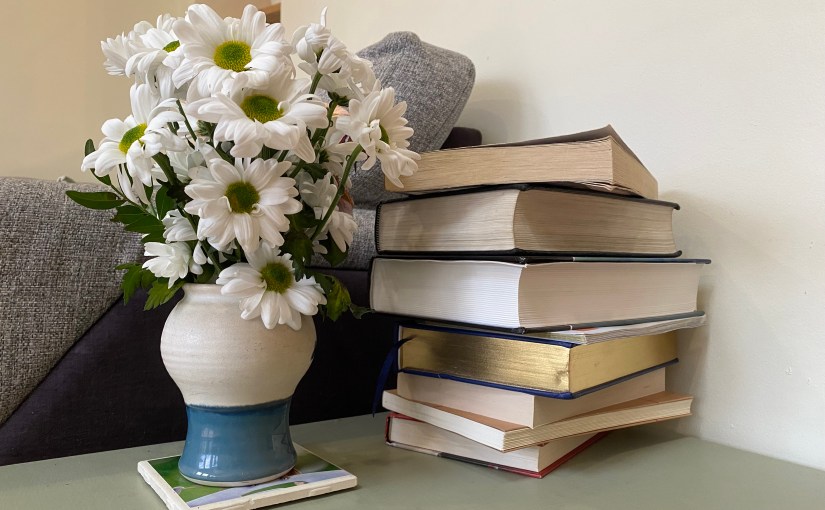
Class was finished for the day at Munster Bible College. As my friend looked over the school’s library, he said, “I never used to read at all before I came here. I just looked at movies and videos and stuff like that. But then I had to read for class, and now I can’t wait to get my hands on more books. I had no idea how many treasures there are in those pages!”
I had never thought of a book as a treasure chest before. A treasure chest just looks like a bit of wood, a normal storage container. A book is made of wood as well, pulped thin and bound together. The goods stored inside it aren’t piled up, they’re drawn out into lines of squiggled ink that would be worthless except for the meaning they’re imbued with, the clusters of agreed letters forming words with agreed meanings representing the ideas that grew in someone else’s mind—the internal thoughts of another human soul translated from their consciousness onto an external medium that you can now hold and interpret and understand. Some fantasy stories include magic books that can see into the past or the future, but my shelves are full of magic books that open portals into the minds and imaginations of other humans—even people who lived long ago, who I could never talk to, yet in their books I hear them talk to me, telling me stories and sharing their wisdom.
A book is a treasure chest for thoughts. Crack open the covers, and you’ll find a wealth of ideas in its words. They can take you out of yourself and show you new places and new perspectives. I learned new things about friendship with God from a monk who washed dishes in medieval France. I learned about courage in the face of overwhelming evil from a fictional story set in a fictional world, written by a man I’ve never met who lived through the overwhelming evil of a world at war. I learned how to face pain and suffering with trust, contentment, and even joy from a woman who has lived most of her life quadriplegic, in a wheelchair. I haven’t done that. But she opened her mind to me in a book, and I benefitted from her thoughts. Books can show you new truths you hadn’t thought of, and old truths from new angles you never noticed before. Books can show you lies, as well, and inconsistencies and biases and gaps and misrepresentations—and if you’re careful that can benefit you, too, because the process of thinking through the problems in the thinking of others can help to shore up the gaps in your own thoughts.
Thinking is hard work. Books can, however, give you new companions in that work. Friends from far away and long ago, who can join the work beside you. Social media can’t replicate this with its stream of short, snappy snippets. Most properly developed thoughts don’t fit well into five second videos or two-sentence statements, and even blog posts can only go so far (says the author, on his blog). Podcasts and films and documentaries can be useful, but most of the world’s great treasures of thought and imagination are found between the treasure-chest binding of good books. To access them and claim their wealth, you must take up and read.
Let’s be honest: reading isn’t always easy. My attention span is shorter than it used to be. I feel it. Life is busy. I also read painfully slowly. To make space for reading, I’ve deleted the games on my devices, but I still find it hard to pick up a book instead of scrolling through endless headlines and mind-numbing posts, advertisements, and internet slop. Here are three things that have helped me greatly to stay engaged with reading:
First, remember that it’s okay to read a little bit at a time. You can actually just read a few pages or one chapter, put the book down, and move on to something else. It’s ok. Even a few minutes spent in someone else’s thoughts can expand the reach and capacity of your own. And as you engage your mind with short segments, your capacity to read for longer periods will also grow.
Second, I’ve found that it’s important to choose books carefully. Some books have very little to say, and take a long time saying it. Some are poorly written, or poorly thought out. Others are so good that once you start, you’ll never want to put them down. If you get bogged down in a bad book, put it down and get something else to read. I’ve found it helpful to get recommendations from people I trust for books (of all genres and eras) that hide the most treasure between their pages.
Third, take one day of rest every week. This might not sound like it has much to do with reading, but it’s been one of the most helpful things for my reading life. It was God’s idea to stop working one day out of seven, and I’ve found that this habit clears my mind and gives me space to refresh it with new thoughts, as well.
If you’re not in the habit of reading, I’d encourage you to make a start, even if it’s small. If you do read already, I’d love to hear any books you’ve enjoyed recently. I just finished “Everything is Never Enough” by Bobby Jamison, and it’s a perspective-changer that I can’t stop thinking about. I recommend it. I also recently enjoyed “Dr. Jekyll and Mr. Hyde”, which is the kind of fiction that helps you think more clearly about reality. What are you reading?
 sethlewis.ie
Thanks for another insightful post. I was a late bloomer when it comes to reading. Recently, I finished Theo of Golden by Allen Levi. This work was one that was hard to put down. For the last few years I have read John Newbery Award children’s books. These books are fun to read and well written.
LikeLiked by 2 people
Thank you, Kelly! You’re right, Theo is excellent! And I like the Newberry award idea
LikeLiked by 1 person
I just finished “Theo of Golden,” a tale of an old man who spends the last year of his long life giving hope and new perspectives to others in his adopted town. Fantastic read and inspiring, too!
LikeLiked by 2 people
Yes! I read that one last year and really enjoyed it!
LikeLiked by 1 person
I enjoyed reading “The Alchemist” from Paulo Coelho, maybe a cliche book for some, but it was the book that made me start loving reading more intensely. Other than this, I’m reading all books under the heavens about parenting young kids… tough subject! 😅
LikeLiked by 2 people
Thank you! I’ll have to look that one up. And yes, it’s great to be able to get wisdom from others on important subjects like parenting!
LikeLiked by 1 person
Thank you for this article! I appreciate the encouragement as I am often discouraged by my lack of consistency in reading. Lately, I’ve been re-reading Andrew Peterson’s “The Wingfeather Saga” and a book on how to lament.
LikeLiked by 1 person
Thanks Hayden! My children love “The Wingfeather Saga”, so I just started the first book myself. It’s great so far!
LikeLiked by 1 person
I love the analogy of a book as a treasure chest for thoughts! I have benefited by them so much over the years.
Some time ago I set myself a mission to read the Dickens books I was unfamiliar with. David Copperfield and A Tale of Two Cities were my favorites of his (read multiple times), and I had read Oliver Twist and Great Expectations. It’s been good to explore his lesser-known works. I just finished the last one–not the last written, but the last I got to–Barnaby Rudge. It’s early subtitle was “A Tale of the Riots of ‘Eighty”–what was called the Gordon Riots of 1780. That didn’t sound very interesting at all. But I trusted that Dickens would write a good, redemptive story with an array of interesting characters–and he did!
I’m also reading Rebel with a Cause, the autobiography of Franklin Graham. It wasn’t on my radar, but it was given to me. I’m enjoying it.
LikeLiked by 1 person
Thank you for sharing these, Barbara! I’d never heard of Barnaby Rudge, but you’re right – Dickens is an incredible writer. I’ve only read his highlights, I suppose – there’s so much treasure out there!
LikeLiked by 1 person