Beside a country road in Ireland there are two tall pillars marking the entrance to my friend’s home, down a lane that used to lead to a massive manor house. That mansion is long gone, but the stately pillars remain as crumbling reminders of its past glories. The gravel lane between them now winds its way to the old farm buildings on the estate, which were nothing but ruined walls until my friend rebuilt them into a home. Outside, the chickens wander freely with the dogs among the garden beds and fruit trees.
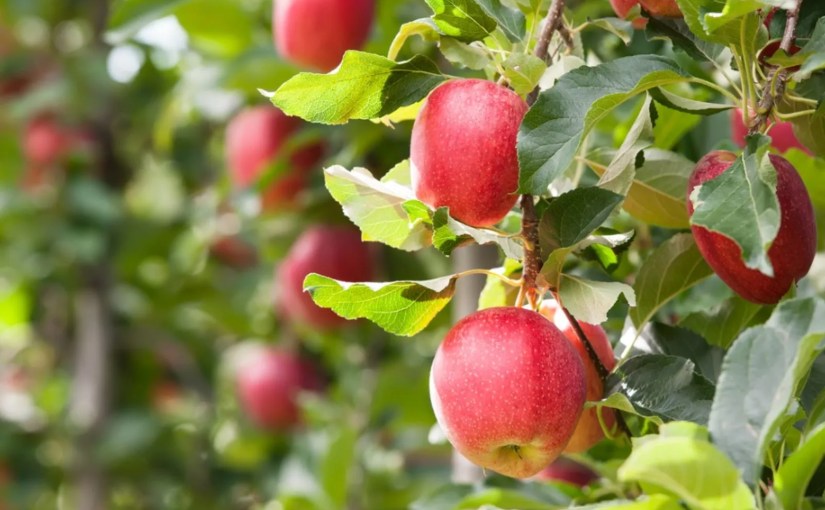
The fruit trees are old. The apple trees beside the house have grown thick with the passing years, with sturdy trunks and branches strong enough to hold hundreds of large apples. One tree in particular stands out from the others. Its trunk is still strong, but it leans precipitously over towards the ground—the result of some terrible storm that nearly toppled it. Somehow, it managed to stay halfway up. Ever since, that apple tree has lived on in its stooped position, adjusting the course of its branches to reach upwards from its tilted trunk. Some of its roots are still sticking up out of the ground. The trunk will never again be able to stand straight and tall like the others. There’s no way that tree could ever hide the fact that it has seen terrible trouble. And yet, for all that, the tree still fills up with apples every year.
The old crooked apple tree beside my friend’s home in a restored ruin encourages me. Living in this broken world brings trouble to humans, too—sometimes serious trouble that nearly takes us under and leaves us stooped and wounded. Sometimes what is damaged cannot be hidden. Sometimes the consequences cannot be straightened out. And yet, for all that, we can still bear fruit. We don’t always have to stand straight and stately to bear the sweet fruit of love, joy, peace, patience, kindness, goodness, faithfulness, gentleness, and self-control—the fruit of God’s Spirit, as listed in Galatians 5. These fruits can grow quite well on crooked trees. When the Apostle Paul asked God to remove his life-altering weakness, God said, “My grace is sufficient for you, for my power is made perfect in weakness” and Paul responded with, “Therefore I will boast all the more gladly about my weaknesses, so that Christ’s power may rest on me” (2 Corinthians 12:9). His goal was not to be the most impressive, leafy, well-proportioned tree possible so that everyone would admire him—his goal was to bear the abundant fruit of God’s power at work in his life. At the end of the day, I’d much rather be a crooked tree laden with good fruit than a perfectly proportioned one with empty limbs or sour apples.
 sethlewis.ie
wow! This is really encouraging indeed. Thanks for sharing these powerful words. God bless you.
LikeLiked by 1 person
This is a truly lovely piece, Seth. You’ve captured the essence of the old apple tree so vividly, and your reflections on its character and resilience are very touching. The imperfections you describe only add to its charm and story.
It made me think about the Japanese philosophy of wabi-sabi, which embraces the beauty of things that are imperfect, impermanent, and incomplete. Do you see a connection between this philosophy and the way you perceive the beauty of the crooked apple tree? Perhaps you could share some other examples in nature that you find captivating for their imperfections.
LikeLiked by 1 person
Thanks Andrew. I don’t know much about wabi-sabi, but it sounds like there would be a connection. I chose this specific example from nature because of its connection to bearing fruit, which is such a strong metaphor in Scripture. I’m sure there are many other natural examples of good coming out of bad situations, though.
LikeLike